Chromosomes
The genetic material in plants, animals, and fungi is called deoxyribonucleic acid (DNA), a long, linear polymer that is physically organized at the microscopic level into chromosomes. Chromosomes are threadlike cellular structures made up of elaborately packaged DNA complexed with proteins. When a cell reproduces itself to make two identical daughter cells, the chromosomes are replicated and divided so that each daughter cell has the same genetic and DNA content. The chromosome division process is called mitosis. During mitosis the individual chromosomes can be stained and seen under a microscope.
Genes code for the production of structural proteins and enzymes and are located at specific sites along the DNA. These sites are called loci (singular: locus) and represent a sort of chromosomal street address for the basic units of heredity, the genes. Genetic loci number in the tens of thousands for most plant species, and they are physically linked if they reside on the same chromosome.
Plant chromosomes replicate and divide in a typical fashion. They are also subject to a type of molecular infection by small, self-replicating, or mobile, pieces of DNA called transposable DNA elements (or transposons), which can hop from one chromosome to another, as described below.
Historically, some important basic principles of genetics and heredity have come from the scientific study of plants. In his classic work on the transmission of traits (such as wrinkled seed) in peas, Gregor Mendel discovered the basic rules of heredity. Mendel showed that both mother (egg) and father (pollen sperm) contribute genetic factors to the next generation by cell union at fertilization. Similarly, the discovery of the existence of jumping genes (described below) was made by Barbara McClintock in her work on corn (Zea mays).
Plant chromosome research has come full circle in the new millenium with the ability to relate molecular structure to whole plant function. For instance, the wrinkled seed trait studied by Mendel was recently discovered to have been caused by a transposon that hopped into and broke a gene involved in filling the pea seed with starch. Mendel was able to track the broken gene through multiple generations by observing the inheritance of the wrinkled seed trait. Understanding plant chromosome structure and function helps bridge the gap between molecular biology and whole plant biology.
Physical Description
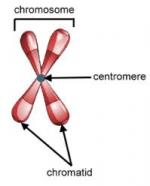
DNA does not exist in the cell as an isolated chemical, but rather as an elaborately packaged and microscopically visible structure called a chromosome. All chromosomes are comprised of both DNA and proteins, although only the DNA contains the genetic code. Each chromosome carries thousands of genes, and each time a cell divides all of the cell's chromosomes are replicated, divided, and sorted into two pools, one for each new daughtercell. Each chromosome has a centromere (the site on the chromosome where the spindle attaches), which functions as a "luggage handle" for the genetic cargo. This attachment provides the mechanical basis for movement of chromosomes toward one of the two pointed ends (poles) of the football-shaped spindle apparatus.
The anaphase stage of mitosis in the cell of an allium root. The chromosomes, replicated and condensed into chromatids, are lined up along an axis.
The entire complement of chromosomes in a given cell or for a given species is referred to as the genome. Plant genomes vary in total DNA content from one species to the next, yet they all have a similar number of functional genes (between fifty and one hundred thousand per individual) required to support the life cycle of a typical plant.
Chromosome Pairing and Segregation
Because most plant species reproduce sexually, they have genomes consisting of two complete sets of genetic instructions, one from each parent, just like humanoids. Most cells of the plant body (stems, roots, leaves) carry this duplicate set, which makes them diploid.
During meiosis, the genome content gets reduced to one complete set of chromosomes per cell, producing gamete cells that are said to be haploid. The male haploid cells in flowering plants give rise to the pollen grains (sperm) whereas the female haploid cells give rise to eggs. As with animals, the diploid state is restored at fertilization by the union of DNA from the sperm and egg cells. Thus the plant life cycle is frequently divided into twomajor stages: the diploid stage (2N), which occurs after fertilization; and the haploid stage (1N), which occurs after meiosis.
A replicated chromosome consists of two identical sister chromatids that remain connected by a centromere. At mitosis, all the chromosomes attach their replicated and connected centromeres to a bipolar spindle apparatus. For each replicated chromosome, the two centromeres become attached to spindle fibers pointing in opposite directions (the metaphase stage of mitosis). Moving along the spindle fibers (the anaphase stage of mitosis), the sister chromatids of each replicated chromosome separate and move to opposite poles. Thus mitosis ensures that when a single cell divides into two, each new daughter cell is equipped with a complete and equal set of genetic instructions. After fertilization, the zygote grows into an embryo and then an adult by using mitosis until the time for sexual reproduction (flowering).
When producing sperm and egg cells for sexual reproduction, the genetic content must first be reduced from diploid to haploid. This reduction is accomplished by meiosis, a specialized process involving two sequential nuclear DNA divisions without an intervening DNA replication step. The first division requires the matching diploid chromosomes to pair, two-bytwo, then segregate away from each other to reduce the genome from diploid to haploid. This chromosome pairing is necessary for proper chromosome segregation and much of the genetic shuffling that takes place from one generation to the next. The second meiotic division is like mitosis and divides replicated chromosomes into the haploid gamete-producing cells. Plant pollen mother cells that undergo meiosis provide excellent cytogenetic specimens to study because the cells and chromosomes are easy to see under the microscope.
Transposable Elements
Transposable DNA elements are sometimes called "jumping genes" because they can move around within the genome. The earliest evidence for the existence of these transposons came from analysis of certain strains of corn by McClintock. At the time in the 1940s, the idea that some parts of the chromosome could be mobile contradicted the notion that the chromosome was a stable, single structure. McClintock's pioneering work on transposons was formally recognized in 1983 when she was awarded a Nobel Prize. The activity of transposons sometimes causes visible features such as stripes and speckles on seeds (such as maize or beans) or flowers (such as petunias).
Transposons are active in most species of plants and animals, and their hopping around can change or even break individual genes. Thus transposons are thought to provide a source of genetic variation within the gene pool of a breeding population. In recent years, many plant transposons have been isolated molecularly (cloned) and used as tools to study plant genetics and create new genetic variations (mutations) by a technique called transposon mutagenesis.
Cell Cycle; Flowers; Genetic Engineering; Mcclintock, Barbara; Reproduction, Sexual.
Bibliography
John, Bernard. Meiosis. New York: Cambridge University Press, 1990.
Fedoroff, Nina, and David Botstein. The Dynamic Genome: Barbara McClintock's Ideas in the Century of Genetics. Plainview, NY: Cold Spring Harbor Laboratory Press, 1992.
This is the complete article, containing 1,181 words
(approx. 4 pages at 300 words per page).