BookRags.com Literature Guides Literature
Guides
Criticism & Essays Criticism &
Essays
Questions & Answers Questions &
Answers
Lesson Plans Lesson
Plans
My Bibliography Periodic Table U.S. Presidents Shakespeare Sonnet Shake-Up
Research Anything:        
History | Encyclopedias | Films | News | Create a Bibliography | More... Login | Register | Help

Search "Chromosome"

Contents Navigation
 

Chromosome

Print-Friendly  Order the PDF version  Order the RTF version
About 2 pages (529 words)
Chromosome Summary

Bookmark and Share Questions on this topic? Just ask!

Chromosome

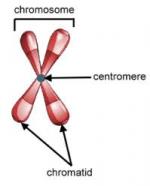
Chromosomes are thread-like bodies in the cell nucleus of all plants and animals that hold the genes--the blueprints of heredity. Each chromosome carries a single strand of deoxyribonucleic acid (DNA) that threads together about 1,000 genes.

Not much was known about chromosomes prior to the 1880s, due to the lack of adequate cell staining techniques and poor microscopes. In 1879, however, Walther Flemming, using new synthetic dyes, was able to discern bodies in cells that had previously gone undetected. He noticed that some material scattered throughout the nucleus heavily absorbed the dye and coined the word chromatin to describe this dark, stainable substance. Upon further observation, he noted that when a cell divided into two daughter cells, the chromatin first doubled, then split lengthwise, leaving each daughter cell with the same amount of chromatin as the parent cell. By 1882, Flemming had identified all the stages of this process, a fundamental operation of cell division now termed mitosis. In 1887, Edouard van Beneden observed a different form of division in sex cells. Rather than doubling, the chromatin split in half, with each half being distributed to the daughter cells. This phenomena was later named meiosis.

In 1888, the German anatomist Wilhelm von Waldeyer-Hartz renamed Flemming's chromatin chromosomes, meaning colored bodies. However, the connection between chromosomes and heredity was not made until 1902, when Walter S. Sutton published a short scientific article concerning the newly discovered work of Gregor Mendel. Sutton proposed that the "factors" which Mendel could not identify, but believed controlled heredity, were indeed contained in the chromosomes. Theodor Boveri independently came to a very similar conclusion, and in 1903, their work became known as the Chromosomal Theory of Inheritance.

For many scientists, the theories of Mendel and Sutton provided a sufficient explanation for heredity and evolution. However, the American geneticist Thomas Hunt Morgan remained skeptical of their work because the conclusions were speculative, based on nothing more than observation, inference, and analogy. Morgan wanted to draw firm conclusions based on quantitative and analytical data and so set out to test their theories using the fruit fly as his subject. The results of his experiments and those of his assistant Hermann Muller contributed greatly to the understanding of chromosomes and their role in heredity. Morgan found that genes--the term Wilhelm Johannsen coined for Mendel's "factors"--were located on chromosomes. For the first time, the association of one or more hereditary traits with specific chromosomes was clear. He also discovered that genes on the same chromosome were often inherited together--an occurrence known as autosomal linkage. (Autosome is the name given to all the chromosomes that are not sex chromosomes.) However, chromosome pairs would sometimes break apart and exchange pieces--a process known as crossing over. The findings of Morgan and his colleagues focused the attention of the scientific world on chromosomes and prompted further research in the area of genetics.

In 1997, artificial human chromosomes were created for the first time by Huntington Willard and his colleagues at Case Western Reserve University in Cleveland, Ohio. Such artificial chromosomes may help scientists understand better how natural chromosomes work. They may also one day be used as a vehicle for carrying DNA into patients receiving gene therapy.

This is the complete article, containing 529 words (approx. 2 pages at 300 words per page).

More Information
  • View Chromosome Study Pack
  • Search Results for "Chromosome"
  • Add This to Your Bibliography
  • More Products on This Subject
    Heinrich Wilhelm Gottfried von Waldeyer-Hartz
    Heinrich Wilhelm Gottfried von Waldeyer-Hartz was a professor of anatomy and histology who coined t... more

    Heinrich Wilhelm Gottfried von Waldeyer-Hartz
    Heinrich Wilhelm Gottfried von Waldeyer-Hartz was a professor of anatomy and histology who coined t... more


    Ask any question on Chromosome and get it answered FAST!
    Answer questions in BookRags Q&A and earn points toward
    discounted or even FREE Study Guides and other BookRags products!
    Learn more about BookRags Q&A
    Copyrights
    Chromosome from World of Chemistry. ©2005-2006 Thomson Gale, a part of the Thomson Corporation. All rights reserved.

    Join BookRagslearn moreJoin BookRags


    About BookRags | Customer Service | Report an Error | Terms of Use | Privacy Policy