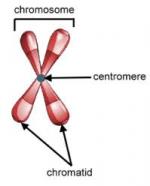
Chromosome segregation refers to the coordinated movement of chromosomes to opposite poles of the cell during either cellular reproduction (mitosis) or the production of sex cells (meiosis). Chromosomes segregate along the spindle apparatus, a microtubule-based structure that attaches at a site called the kinetochore to the chromosomes centromere during anaphase of mitosis. To ensure equal segregation, sister chromatids are linked together from the time of their synthesis (S-phase of the cell cycle) to the time of their segregation. Without segregation of chromosomes, there would be no way to pass on genetic information from one cell to the next. This process, however, is not flawless. Chromosome abnormalities can arise when chromosomes undergo rearrangements or fail to segregate properly. These alterations can be of a structural or numerical nature. Numerical anomalies result in aneuploidy, or addition or loss of individual chromosomes from the normal set of 46. If the anomaly involves the addition of a complete set of chromosomes, it is called polyloidy. Structural abnormalities are rearrangements of genetic material within or between chromosomes. Rearrangements of this sort can be balanced, meaning that there is no loss in genetic material, or unbalanced, meaning that there is a gain or loss of part of the chromosome.
Numerical anomalies typically result from the failure of chromosomes to segregate properly, a phenomenon called nondisjunction. Nondisjunction during the first division of meiosis (meiosis I) results from failure of homologous chromosomes to segregate to opposite poles of the cell. Nondisjunction can also occur at the second division of meiosis (meiosis II) due to failure of sister chromatids to segregate. Both events result in gametes that are either disomic, meaning there is an extra chromosome, or nullisomic, meaning that there is a loss of a chromosome. During fertilization, a nullisomic gamete that unites with a numerically normal gamete results in a zygote that has monosomy, or one less chromosome than normal. A disomic gamete that unites with a numerically normal gamete will result in trisomy, or in other words, the zygote will have an extra chromosome. Most monosomic zygotes spontaneously abort. An example of a monosomic zygote that can survive is Turner syndrome, which results from the loss of one X chromosome. Although trisomic zygotes also frequently abort, a zygote that is trisomic for chromosome 21, or Trisomy 21 (also known as Down syndrome), can survive.
Rearrangements that result in fusion or breakage of chromosomal material often become unstable during division leading to cell death. There are, however, structural alterations in humans can result in stable chromosomes, inherited from one generation to the next. Inheritance of balanced or unbalanced chromosomes depends on how the chromosomes segregate. Chromosomes can segregate in three distinct ways. When adjacent chromosomes with nonhomologous (of different chromosome number) centromeres move to daughter cells, it is considered Adjacent 1 segregation. Adjacent 2 segregation refers to movement of adjacent chromosomes with homologous (chromosome that are the same chromosome number) centromeres to the same daughter cell. Finally, alternate segregation occurs when alternate chromosomes with nonhomologous centromeres to move to daughter cells. The main kinds of structural alterations are deletions, duplications, inversions, isochromosomes, and translocations.
Deletions involve segments that are missing from a chromosome. If the chromosome break occurs at the end of the chromosome (a terminal deletion), then the fragment broken off is lost during the next cell division. Another type of deletion is an interstitial deletion that arises from two different breaks on either side of the centromere. The breakpoints fuse together, with loss of the acentric fragment (the fragment that does not contain the centromere). If the breakpoints involve both terminal ends of a chromosome, the ends can fuse together creating a ring chromosome. Ring chromosomes, therefore, have missing segments on both arms (p and q) of the chromosome.
Isochromosomes are duplications along the entire length of one arm (p or q) of the chromosome with loss of material from the unduplicated arm. Typically, these are unstable and do not survive unless the isochromosome involves an acrocentric chromosome, or a chromosome that has the centromere positioned near the end of the chromosome. Isochromosomes that result from two acrocentric chromosomes joined together can lead to trisomic gametes. For example, an isochromosome 21 balanced carrier would have gametes that would result in either Trisomy 21 or monosomy 21 conceptuses (assuming it is fertilized with a normal gamete). Most conceptuses would spontaneously abort, including all monosomic and most trisomic conceptuses. The only surviving conceptuses in this case would be Trisomy 21 and would, therefore, have Down syndrome. Stated differently, all conceptuses from an isochromosome 21 carrier would have Down syndrome and there would be no normal conceptuses. Isochromosomes, which are exceedingly rare, can also arise from a longitudinal separation during division resulting in two short arms (p) and two long arms (q).
Rearrangements that involve breaks in two different chromosomes can often lead to fusion of the acentric fragments to the nonhomologous chromosome counterpart. This is called a translocation. If this happens during meiosis, the gametes can be either normal, carriers of an unbalanced rearrangement, or carriers of a balanced rearrangement. Reciprocal translocation results in two break points with an exchange of material anywhere along the chromosome. Fusion of nonhomologous, acrocentric chromosomes (chromosomes 13-15, 21 and 22) where breakpoints that form these rearrangements are at or near the centromeres of both chromosomes involved are called Robertsonian translocations.
Fusion of two breaks in a chromosome is called an inversion if the fragment is reinserted in an inverted position. Inversions can be pericentric, with breakpoints involving the centromere, or paracentric, where breakpoints are on the same side of the centromere.
Duplications result from extra chromosomal material with segments being genetically identical in sequence to part of a chromosome. Repetitive sequences often become duplicated either as inverted repeats or direct tandem repeats. Duplications can also result from unbalanced translocations or inversions.
Chromosomal segregation and rearrangement aberrations can occur in either mitosis or meiosis, resulting in two distinct cellular fates. First, if the aberrant segregation occurs during mitosis, all cells derived from the abnormal cell will inherit the abnormality. This is called a mosaic cell line or mosacism because only a proportion of the cells in the body will manifest the aberration. Secondly, if the aberrant segregation or rearrangement takes place during meiosis, all the cells in the body will manifest the abnormality. This has clinical significance in that if only a proportion of the cells have the abnormality, then the nature of the defect will be variable depending on the number of cells that are abnormal. Clearly, proper segregation of chromosomes is paramount in maintaining the appropriate number and amount of genes that are expressed within the cell. Learning the mechanisms by which chromosomes aberrantly segregate or rearrange is important in understanding basic tenets involved in human genetic diseases.
This is the complete article, containing 1,123 words
(approx. 4 pages at 300 words per page).