BookRags.com Literature Guides Literature
Guides
Criticism & Essays Criticism &
Essays
Questions & Answers Questions &
Answers
Lesson Plans Lesson
Plans
My Bibliography Periodic Table U.S. Presidents Shakespeare Sonnet Shake-Up
Research Anything:        
History | Encyclopedias | Films | News | Create a Bibliography | More... Login | Register | Help

Not What You Meant?  There are 13 definitions for Channing.

Channing, William Ellery (1780–1842)

Print-Friendly  Order the PDF version  Order the RTF version
About 3 pages (755 words)
William Ellery Channing Summary

Bookmark and Share Know this topic well? Help others and get FREE products!

Channing, William Ellery(1780–1842)

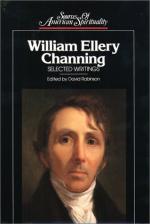
William Ellery Channing, America's most famous Unitarian minister, was described by Ralph Waldo Emerson as "one of those men who vindicate the power of the American race to produce greatness." Channing, born in Newport, Rhode Island, was graduated from Harvard in 1798. The following two years he spent as a tutor in Richmond, Virginia, and in private study. During this period he underwent a profound religious experience, and in 1801 he returned to Harvard for theological study. He was ordained the minister of Boston's Federal Street Congregational Church in 1803 and held this pastorate throughout his life. He died in Bennington, Vermont.

Channing was not an original or profound thinker, a systematic philosopher, or a great writer. His significance in the history of ideas lies in his representative influence, his achievement in expressing and synthesizing the diverse strands of thought that appeared in America at the end of the eighteenth and the beginning of the nineteenth centuries.

Although Channing was celebrated in his own lifetime as a man of letters (his critical essays on John Milton, Napoleon Bonaparte, and François Fénelon were widely read both here and abroad), his lasting reputation stands on his attempt to develop an "enlightened" religious faith for the Americans of his generation. Jonathan Edwards had responded to the spirit of the Enlightenment by employing the ideas of John Locke and Isaac Newton to revitalize Calvinist dogma. Channing employed the liberating spirit of eighteenth-century thought to free Christianity from an outmoded theology. "God has given us a rational nature," he said in his famous sermon "Unitarian Christianity" (1819), "and will call us to account for it." Without denying the authority of Scripture, Channing argued that men should "reason about the Bible precisely as civilians do about the Constitution under which we live." This rational approach to revelation led Channing to reject the "irrational and unscriptural doctrine of the Trinity." Substituting the moral perfection of God for the Calvinist conception of divine sovereignty, Channing also repudiated such doctrines as natural depravity and predestination. "It is not because his will is irresistible but because his will is the perfection of virtue that we pay him allegiance," Channing asserted. "We cannot bow before a being, however great and powerful, who governs tyrannically."

As a religious thinker Channing was liberal but not radical. Eighteenth-century skepticism had no place in his thinking. He was influenced considerably by Scottish "commonsense" philosophers, such as Adam Ferguson and Richard Price, and in his discourse "The Evidences of Revealed Religion" (1821) he relied heavily on the traditional arguments of William Paley in attempting to refute David Hume and assert the validity of miracles.

Channing is also important for his influence on the New England transcendentalists. Like Jean-Jacques Rousseau, whose writings he admired, he was partly an Enlightenment figure and partly a romantic. Channing's romanticism is most apparent in the sermon "Likeness to God" (1828), in which he asserted that humankind discovers God not only through Scripture and rational inquiry but also through consciousness. Long before Emerson's famous essays were published, Channing was preaching that in all its higher actions the soul had "a character of infinity" and describing sin as "the ruin of God's noblest work." Despite the fact that Channing never professed enthusiasm for the "new views," the similarity between his conception of the divine potential in human nature and the later pronouncements of Emerson and Theodore Parker is unmistakable. The path to transcendentalism lay through Unitarianism, and it was Channing who helped to pave the way.

Finally, Channing is significant for his humanitarian influence. His belief in the parental character of God and the dignity of humanity provided an ideological base for humanitarian efforts, and he spoke out in favor of most of the reform causes of his day. His pamphlet against slavery, written in 1835, attracted wide attention. Although Channing always shied away from radical solutions to social disorder, no one was more influential in articulating the gospel of human dignity that nourished most American reformers before the Civil War.

Edwards, Jonathan; Emerson, Ralph Waldo; Enlightenment; Fénelon, François De Salignac De La Mothe; Ferguson, Adam; Hume, David; Locke, John; Milton, John; Newton, Isaac; Paley, William; Parker, Theodore; Price, Richard; Rousseau, Jean-Jacques.

Bibliography

The most usable edition of Channing's works is a one-volume edition (Boston, 1886). There are several full-length studies of Channing, including David Edgell's William Ellery Channing: An Intellectual Portrait (Boston: Beacon Press, 1955); Arthur Brown's Always Young for Liberty (Syracuse, NY: Syracuse University Press, 1956); and Robert L. Patterson's The Philosophy of William Ellery Channing (New York: Bookman Associates, 1952).

This is the complete article, containing 755 words (approx. 3 pages at 300 words per page).

More Information
  • View Channing, William Ellery (1780–1842) Study Pack
  • 13 Alternative Definitions
  • Search Results for "Channing, William Ellery (1780–1842)"
  • Add This to Your Bibliography
  • More Products on This Subject
    William Ellery Channing
    William Ellery Channing (1780-1842), an American minister, was a key Unitarian theologian for the m... more

    William Ellery Channing
    Though he wrote only a few works that dealt expressly with literature, William Ellery Channing infl... more


    Ask any question on William Ellery Channing and get it answered FAST!
    Answer questions in BookRags Q&A and earn points toward
    discounted or even FREE Study Guides and other BookRags products!
    Learn more about BookRags Q&A
    Copyrights
    Channing, William Ellery (1780–1842) from Encyclopedia of Philosophy. Copyright © 2001-2006 by Macmillan Reference USA, an imprint of the Gale Group. All rights reserved.

    Join BookRagslearn moreJoin BookRags


    About BookRags | Customer Service | Report an Error | Terms of Use | Privacy Policy