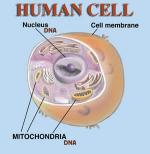
The cell is the basic unit of life. The cell theory, set forth in the 1850's, states that cells are the fundamental units of life, because a cell is the simplest unit capable of independent existence. All living things are made of cells. They are made up of 90% water. The rest of the present molecules are 50% protein, 15% carbohydrate, 15% nucleic acid, 10% lipids and 10% others.
Two types of cells are recognized in living things. Prokaryotes (literally, "before the nucleus") are cells that have no distinct nucleus that is found to float around the cell. Most prokaryotic organisms are single-celled, such as bacteria and algae. Eucaryotic (literally, "true nucleus") organisms, on the other hand, have a distinct nucleus and a highly organized internal structure. The nucleus directs all cellular activities by controlling the synthesis of proteins. The nucleus contains encoded instructions for the synthesis of proteins in a helical double-stranded molecule called deoxyribonucleic acid (DNA). When the cells multiply, the double helix of the DNA is unwound. Each strand of the DNA molecule is then used as a template for the production of a new strand. Each such DNA then goes into daughter cells. This process is called replication and occurs in slightly different ways in prokaryotes and eucaryotes. The study of the transmission of such information is called genetics. Each cell in this way inherits the information for directing the production of the same proteins as the parent cell.
The first step in protein synthesis begins in the nucleus. Within the nucleus, the DNA is used as a template to produce molecules called messenger ribonucleic acid (mRNA). A segment of DNA coding for an RNA sequence is called a gene. Once in the cytoplasm, mRNA attaches to ribosomes (either bound to endoplasmic reticulum or free in the cytoplasm) and initiates protein synthesis by a process called translation. Proteins made for export from the cell function as enzymes that participate in all the organism's chemical reactions. Because enzymes are essential for all the body's chemical processes--from cellular respiration to digestion--direction of the synthesis of these enzymes in essence controls all the activities of the body. Therefore, the nucleus, which contains the instructions for the synthesis of these proteins, directs all cellular activities and thus, all body processes.
It is important to recognize that cells also contain additional DNA molecules called plasmids. These are molecules of small DNA present in bacteria and eucaryotes. Bacterial plasmids for example are circular DNA molecules present in the cytoplasm. Plasmids endow the cells in which they exist with nonessential but important functions, such as antibiotic resistance. In genetic engineering they play an important role as important vectors (vehicles) in recombinant DNA technology.
Prokaryotes are organisms of volume 10-12 ml per cell, which can grow rapidly and are widespread in the biosphere. Some of them can double size, mass and number in 20 minutes. They are highly versatile and can survive in a wide variety of nutrients and environments. These cells of these organisms have a rigid cell wall immediately inside which is a cell membrane, which play a critical role in the transfer of chemical to and from the cells. Under a microscope, grainy dark spots distinctly apparent inside the cells are the ribosome's, which are the sites of important chemical reactions. Ribosomes do not have a membrane. Ribosome's fall into two separate units while not synthesizing protein. The cytoplasm is the fluid material inside the cell while the bubble-like regions inside the cell are the storage granules. While sharing many common features, prokaryotes have considerable structural and biochemical diversity.
Eucaryotic cells, on the other hand are 1,000 to 10,000 times larger than prokaryotic cells. All cells of plants, animals, and fungi belong to this family. Multi-cellular organisms contain a vast array of highly specialized cells. Plants, for example, contain root cells, leaf cells, and stem cells. Humans have skin cells, nerve cells, and sex cells. Each kind of cell is structured to perform a highly specialized function. In order to meet the many different specialized functions, these cells exist in many different forms. They act in a cooperative manner in multi-cellular organisms. However, many important microbial species are also eucaryotes.
Eucaryotic cells have a substantial degree of spatial organization and differentiation. They have a number of membrane-enclosed domains called organelles inside the cells. Besides the nuclear membrane, which clearly differentiates the nucleus and the ribosome, eukaryotes have a complex convoluted membrane system called the endoplasmic reticulum from the cell wall into the cell. The endoplasmic reticulum is the transport system for molecules needed for certain changes and specific destinations, instead of molecules that float freely in the cytoplasm. There are two types, rough and smooth. Rough ones have ribosomes attached to it, as mentioned before, and smooth ones do not. The mitochondria are highly specialized organelles, which catalyze reactions whose products are major energy supplies to the cell. Mitochondria are the sites of aerobic respiration, and generally are the major energy production center in eucaryotes. Mitochondria have two membranes, an inner membrane and an outer membrane. The reticulations, or many foldings of the inner membrane, serve to increase the surface area of membrane on which membrane-bound reactions can take place. The golgi complex, lysosomes, and vacuoles are the remaining organelles that isolate chemical reactions and chemicals compounds from the cytoplasm. The golgi changes molecules and divides them into small membrane contained sacs called vesicles. These sacs can be sent to various locations in the cell. The lysosome is the digestive system in the cell. It breaks down molecules into their base components digestive enzymes. This demonstrates one of the reasons for having all parts of a cell compartmentalized; the cell could not use the destructive enzymes if they were not sealed off from the rest of the cell. Chloroplasts are the site of photosynthesis in eucaryotic cells. They are disk-like structures composed of a single membrane surrounding a fluid containing stacks of membranous disks. Because of their green color chloroplast are the only organelles that can be easily seen with a light microscope.
The three most common cells used in molecular engineering are the bacterium Escherichia coli, the unicellular yeastSaccharomyces cerevisiae and various animal cell lines. E. coli is commonly used as the host in recombinant DNA technology, while all three cell lines are used for the production of proteins from cloned genes. Frequently after a protein of a eucaryotic organism is synthesized it is modified by enzymatic addition to a lower molecular weight substance. This is required for the proper function of the protein. As E. coli do not have the biosynthetic capacity to bring about these changes, Saccharomyces cerevisiae is often used in such cases.
This is the complete article, containing 1,110 words
(approx. 4 pages at 300 words per page).