Forgot your password?  


Catapult | Research & Encyclopedia Articles

Print-Friendly   Order the PDF version   Order the RTF version
About 2 pages (691 words)
Catapult Summary


Catapult

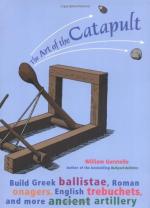
The catapult is an ancient artillery device that used the power of recovery of twisted fibers to hurl projectiles at long range. The invention of torsion artillery and siege engines has been credited to the Greeks. They were using torsion catapults from about 300 b.c.. These catapults used vast quantities of human hair twisted into skeins. There are several recorded instances of gifts between Greek cities of tons of human hair, evidence of how much was needed for these war machines.

The Romans made improvements to the catapultÕs basic design and perfected its use in battle. The simplest of the early catapults used a thick bundle of human hair or animal sinew, with one wooden beam inserted through it. Geared winches were used to twist the hair or sinew without letting it unwind. To load the catapult, soldiers manned a windlass, which pulled the beam down until it was horizontal. A stone was attached to the end of the beam. When a soldier pulled a rope, releasing the beam from its mooring, the beam sprang upward with the energy of the released tension of the twisted hair, flinging the stone with great force. The basic Roman catapult had a single arm that flew up to hurl a stone toward a distant enemy.

In medieval Europe, a catapult that operated like a crossbow came into usage. It had two short arms that moved horizontally instead of one large beam that moved vertically like the earlier Roman catapult. A heavy bowstring connected the ends of the arms. The usual ammunition was a short, heavy javelin. The ballista closely resembled the crossbow-catapult but differed in size; it could weigh up to four tons (3.63 t) and send a 60-pound (27.2 kg) rock as far as 500 yards (457.2 m). Both machines were capable of throwing ammunition at the same target continuously. However, these early devices had their drawbacks. They worked fine in dry weather, but when wet, the fibers lost their resilience and power. Around a.d. 1000, a new type of catapult, called the huo-pa'o, appeared in China; its design was probably based on an irrigation device used in Egypt around 1500 b.c. An unequal lever had a heavy weight attached to the shorter arm. The longer arm was attached to a rope that held a bucket with the ammunition. The arm was then pulled down to engage a hook, the ammunition (stones, most likely) was loaded in the bucket or sling, and the hook was released. The heavy weight on the short arm fell, sending the bucket skyward, thus launching the ammunition. These weapons, called trebuchets by Europeans, appeared throughout the continent in the eleventh and twelfth centuries. The largest trebuchets had 50-foot (15 m) arms and used a 10-ton (9 t) weight, were capable of throwing a 250-pound (114 kg) rock or ball about 900 feet (275 m).

Surprisingly enough, catapults were seen much later in history. In 1849 Richard Hodges received an English patent for an airgun in which a piston was forced up the cylinder by a twisted India-rubber spring. He also invented an elastic-rubber catapult mounted on a gun-shaped stock. Catapult devices were even used in recreational sports, such as trap-shooting, in which elastic catapults hurled inanimate targets in the air for hunters to shoot. An American, Captain Adam Bongardus, created an effective ball trap device for this sport in 1876.

The catapult is used now to launch heavy jet planes from aircraft carriers. Without enough space for a long take-off path, jet planes are hurled into the air from a steel carriage mounted on a catapult arm on the carrier's deck. Developed in World War II, the first airplane catapults were hydraulic. The British developed a steam-driven catapult in 1951, using steam from the carrierÕs boilers. The underbody of the plane rests in a truss mounted on a rolling carriage. This whole assembly is fixed to a turntable so that the it can be rotated to face the airplane into the wind. When the plane is ready for takeoff, it starts its engines, and the catapult arm is released, sending the carriage forward and vaulting the plane safely away from the ship.

This is the complete article, containing 691 words (approx. 2 pages at 300 words per page).

Ask any question on Catapult and get it answered FAST!
Answer questions in BookRags Q&A and earn points toward
discounted or even FREE Study Guides and other BookRags products!
Learn more about BookRags Q&A
Copyrights
Catapult from World of Invention. ©2005-2006 Thomson Gale, a part of the Thomson Corporation. All rights reserved.

Join BookRagslearn moreJoin BookRags

Join BookRagslearn moreJoin BookRags