BookRags.com Literature Guides Literature Guides Criticism/Essays Criticism/Essays Biographies Biographies My Bibliography Periodic Table U.S. Presidents Shakespeare Sonnet Shake-Up
Research Anything:        
History | Encyclopedias | Films | News | Create a Bibliography | More... Login | Register | Help
Not What You Meant?  There are 10 definitions for Gauss.


Carl Friedrich Gauss

Print-Friendly  Order the PDF version  Order the RTF version
About 2 pages (669 words)
Carl Friedrich Gauss Summary

Bookmark and Share

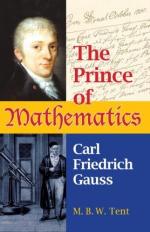
Carl Friedrich Gauss

1777-1855

German Mathematician and Astronomer

Carl Friedrich Gauss holds a place among history's greatest geniuses, such as Sir Isaac Newton (1642-1727) or Albert Einstein (1879-1955). He advanced number theory with his formulation of the complex-number system; laidthe groundwork for modern probability theory, topology, and vector analysis; and, like a few other mathematicians of his day, contributed extensively to the knowledge of astronomy. Gauss is also credited with the invention of a trigonometric measuring device called the heliotrope as well as the bifilar magnetometer and a prototype for the electric telegraph. This interrelation between mathematics and science and the applications of both were central to the worldview of Gauss, who saw mathematics itself as a science.

Gauss's story is particularly intriguing given the fact that he was born into a humble family; his father, Gebhard, was a laborer and merchant and his mother, Dorothea, a functionally illiterate servant woman. His parents, who lived in Brunswick, capital of the German duchy of Braunschweig, did not even record the exact date of his birth. Gauss, their only son, however, was able to calculate the date later because his mother remembered that it was eight days after the Catholic Feast of the Ascension in 1777—April 30.

The boy soon proved himself a prodigy, first by catching his father in an addition mistake when he was just three and, later, by a feat at school. A teacher, hoping to keep the students busy for hours, ordered them to add all the integers from 1 to 100. Gauss, however, independently derived a formula dating back to the time of Pythagoras (c.580-500 B.C.), S = n (n + 1) / 2. He added the smallest and largest integers together in succession, coming up with 50 sets of 101s (1 + 100, 2 + 99, 3 + 98, etc.).

Though his father initially discouraged him from a career in mathematics, Gauss managed to enter secondary school in 1788 and went on to Caroline College in Brunswick. He then entered the University of Göttingen in 1795. Again he showed himself a highly promising mathematician, in 1799 proving that every polynomial equation has a root in the form of the complex number a + bi. Also in 1799, he earned his doctorate from the University of Helmstedt, and, two years later, he published his thesis, Disquisitiones arithmeticae. In 1801, the year of the publication of his thesis, Gauss discovered Ceres, the largest of the asteroids orbiting around the Sun.

Gauss married Johanna Osthoff in 1805 and, though at first he had trouble finding work, in 1807 secured a dual position as director of the university and professor of mathematics at Göttingen. Tragedy struck in 1810, when the couple's third child died soon after birth, with Johanna following shortly thereafter. Gauss was only a widower for a short time before asking Friederica Waldeck, the daughter of a faculty colleague, to marry him. They also had three children, and Gauss would later be widowed a second time when Friederica died of tuberculosis.

Despite misfortunes at home, Gauss continued to conduct highly fruitful research in the realms of mathematics and astronomy. In 1809 he published his most significant work on applied mathematics, Theoria motus corporum celestium. He also performed a number of jobs for various principalities and duchies in Central Europe, traveling and making geodetic surveys. To aid him in his work, he invented a measuring device, the heliotrope, in 1821.

In 1827 Gauss published Disquisitiones generales circa superficies curvas, in which he anticipated Einstein's work by speculating that space was curved. He also continued to teach, but he is not remembered as an especially generous mentor; though he corresponded with Sophie Germain (1776-1831), he did little to cultivate the young minds under his tutelage at Göttingen. Furthermore, he discouraged his own highly talented son, Eugene, from a career in mathematics.

Gauss died on February 23, 1855, of a heart attack. In his lifetime, he received some 75 official honors, including membership in the Royal Society of England. The gauss, a magnetic unit of measurement, is named after him.

This is the complete article, containing 669 words (approx. 2 pages at 300 words per page).

More Information
  • View Carl Friedrich Gauss Study Pack
  • 10 Alternative Definitions
  • Search Results for "Carl Friedrich Gauss"
  • Add This to Your Bibliography
  • More Products on This Subject
    Karl Friedrich Gauss
    The German mathematician Karl Friedrich Gauss (1777-1855) made outstanding contributions to both pu... more

    Carl Friedrich Gauss
    Carl Friedrich Gauss was as eccentric as he was brilliant. Known primarily for his work in mathemat... more


    Copyrights
    Carl Friedrich Gauss from Science and Its Times. ©2005-2006 Thomson Gale, a part of the Thomson Corporation. All rights reserved.

    Join BookRagslearn moreJoin BookRags


    About BookRags | Customer Service | Report an Error | Terms of Use | Privacy Policy