BookRags.com Literature Guides Literature
Guides
Criticism & Essays Criticism &
Essays
Questions & Answers Questions &
Answers
Lesson Plans Lesson
Plans
My Bibliography Periodic Table U.S. Presidents Shakespeare Sonnet Shake-Up
Research Anything:        
History | Encyclopedias | Films | News | Create a Bibliography | More... Login | Register | Help

Not What You Meant?  There are 18 definitions for Cambria.

Cambrian Period

Print-Friendly  Order the PDF version  Order the RTF version
About 3 pages (1,016 words)
Cambrian Summary

Bookmark and Share Know this topic well? Help others and get FREE products!

Cambrian Period

Cambrian is the name given to a period of time in Earth's history (i.e., Cambrian Period), which spanned 570–510 million years ago. The proper name Cambrian is also given to all the rocks that formed during that time (i.e., Cambrian System). In other words, the Cambrian System is the rock record of events that occurred—and organisms that lived—during an interval of geological time called Cambrian Period. Cambrian is the initial period of the Paleozoic Era.

Cambrian is a name derived from the Roman name for Wales, which was Cambria. Wales was the original study location for sedimentary rock formed during this interval of Earth history. The term Cambrian was first used in 1835 by Professor Adam Sedgwick (1785–1873) of Cambridge University, who was studying the lower part of what was then called Transition strata (the oldest known sedimentary rocks) in Wales. Sedgwick was working in the same general area as another prominent stratigrapher of the day, Roderick Merchison (1792–1871), whose focus was upon the overlying Silurian System. Merchison eventually showed that there was some overlap in the original concept of Sedgwick's Cambrian System and his own Silurian System, and ultimately advocated (c. 1852) that the Cambrian System was in fact part of the Silurian. It was not until a comprehensive study of the Cambrian-Silurian overlap problem produced the intervening Ordovician System (1879), that the Cambrian System was fully accepted by all geologists. Since their recognition and definition during the nineteenth century, Cambrian strata have been mapped on all the world's continents.

During Cambrian, the breakup of the supercontinent of Gondwana began with the separation of some landmasses including part of Asia and the ancient continents called Baltica and Laurentia (i.e., proto-North America). During its separation from the main Gondwana land mass, Laurentia had a collision with the southern end of what is now South America (specifically western Argentina), which resulted in some crustal deformation and mountain building. At this time, there was essentially a single world ocean, which is referred to as Panthalassa.

During most of Cambrian, global sea levels were at relatively high elevations as compared with most of the balance of Earth's history. The world's continents were mainly low-lying deserts and alluvial plains, and the rising Cambrian sea—in what is known as the Sauk transgression—encroached upon these areas, thus forming vast epicontinental seas. For example, during most of Cambrian, sea level was so high that an epicontinental sea covered North America except for a series of low islands running southwest-northeast along the elevated middle part of the continent (i.e., the Transcontinental Arch) and some parts of the low-lying Canadian cratonic shield region.

Cambrian was a time of rising global temperatures and Cambrian global climate ultimately became warmer than today. During Cambrian, there were essentially no polar or high-altitude glaciers. Further, there were no continents located at polar positions. The Cambrian Earth likely had more equitable climates than present because of the large amount of surficial seawater (approximately 85% or more, compared to approximately 70% at present) and lack of significant topographic relief. Winds were likely confined to rather well-defined belts, and there is good evidence of persistent trade winds preserved in vast cross-bedded Cambrian sandstones.

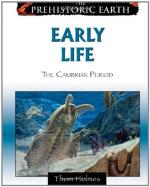
Cambrian life in the oceans was very plentiful, but rather primitive by modern standards. The transition of pre-Cambrian life forms (mainly soft-body impressions in rock) to Cambrian life (shell-bearing fossils and other fossils with hard parts) has been referred to as the "Cambrian explosion." This explosion is more apparent than real, as the main change was the advent of preservable hard parts and shells, which seem to suddenly appear at a level near the onset of Cambrian sedimentation. Cambrian faunas include some very unusual creatures that may represent extinct phyla of organisms or organisms so primitive that they are not easily assigned to extant phyla. The most famous of fossil localities with such Cambrian fossils is at Mount Wapta, British Columbia, Canada (i.e., Burgess Shale outcrops). In these strata, the earliest known chordate (spinal cord-bearing animal), Pikaia, was first found. Other marine creatures of Cambrian seas included the archaeocyathids and stromatoporoids (two extinct, sponge-like organisms that formed reefs), primitive sponges and corals, simple pelecypods and brachiopods (two kinds of bivalves), simple molluscs, primitive echinoderms and jawless fishes, nautiloids, and a diverse group of early arthropods (including many species of trilobites). Trilobites were particularly abundant and diverse, and over 600 genera of Cambrian trilobites are known. Some species of trilobites were the first organisms to develop complex eye structures. Numerous Cambrian reefs, patch reefs, and shallow-water mounds were formed by stromatolites, a layered mass of sediment formed by the daily trapping and binding action of a symbiotic growth of blue-green algae and bacteria.

Cambrian life on land was probably quite limited. There is evidence that stromatolitic growth of blue-green algae and bacteria covered rocks and formed sediment layers at or near oceanic shorelines and lake margins. However, complex life forms are not found in Cambrian terrestrial sediments. It is possible that some arthropods may have lived partially or entirely upon land at this time, but this is speculative in the absence of fossil evidence. There were no land plants at this time, and thus Cambrian landscapes were at the mercy of wind and water erosion without any protection from vegetation. The minimal level of photosynthetic activity before and during Cambrian raised oxygen levels in Earth's atmosphere to approximately 10% of that found in the modern atmosphere.

The end of Cambrian came gradually with falling sea levels and the onset of slightly cooler global temperatures. During Late Cambrian, trilobite species became the first organisms known to experience widespread mass extinction. In several events during Late Cambrian, trilobite faunas were wiped out over vast areas for causes that are not completely understood. Reasons proposed for the mass extinctions include competition with other organisms and rapid shifts in global temperature and/or sea-level changes. Trilobites persisted into Late Paleozoic, but not as prominently as they did in Cambrian seas. Ordovician succeeded Cambrian life and conditions. During Ordovician, plant and animal life continued to diversify, tectonic activity began to be more extensive, and global climate change became more intensive.

Stratigraphy; Supercontinents

This is the complete article, containing 1,016 words (approx. 3 pages at 300 words per page).

More Information
  • View Cambrian Period Study Pack
  • 18 Alternative Definitions
  • Search Results for "Cambrian Period"
  • Add This to Your Bibliography
  • More Products on This Subject
    Cambrian Period
    Oldest time division of the Paleozoic Era. During the Cambrian, 542–488.3 million years ago, ... more

    Cambrian Period
    The Cambrian period (570 million years ago) marks an extraordinary shift in the evolution of life. ... more


    Ask any question on Cambrian and get it answered FAST!
    Answer questions in BookRags Q&A and earn points toward
    discounted or even FREE Study Guides and other BookRags products!
    Learn more about BookRags Q&A
    Copyrights
    Cambrian Period from World of Earth Science. ©2005-2006 Thomson Gale, a part of the Thomson Corporation. All rights reserved.

    Join BookRagslearn moreJoin BookRags


    About BookRags | Customer Service | Report an Error | Terms of Use | Privacy Policy