 Print
Print Word
Word PDF
PDF|
This section contains 7,800 words (approx. 26 pages at 300 words per page) |

|
Introduction
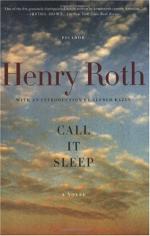
Henry Roth's 1934 novel Call It Sleep is based loosely on the author's own experiences growing up as a Jewish American in New York City during the early 1900s. In the novel, David Schearl is a young boy who must come to terms with conflicting forces in an effort to forge his own identity. The conflicting forces include intense love for and dependence on his mother Genya coupled with fear and hatred for his unstable father Albert. David must also reconcile his Jewish heritage with both his mainstream American tendencies and his curiosity about other cultures and religions.
The novel is notable for its use of Yiddish both directly and indirectly through character dialogue. Most of the dialogue spoken in the Schearl household is in Yiddish, but it is transcribed for the reader in deliberately formal...
|
This section contains 7,800 words (approx. 26 pages at 300 words per page) |
|