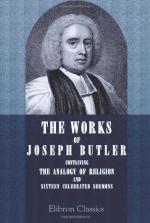
Butler, Joseph
BUTLER, JOSEPH (1692–1752), English theologian and moral philosopher. Butler was born into a Presbyterian family in Berkshire. He began his studies at a dissenting academy, but changed his allegiance to the Church of England and entered Oriel College, Oxford University. After ordination, he held a succession of charges, including clerk of the closet to Queen Caroline, clerk of the closet to King George II, bishop of Bristol, and bishop of Durham. He died at Bath and is buried in the cathedral at Bristol.
The first part of Butler's only systematic work, Analogy of Religion (1736), argued against those deists of his day who, although rejecting the Christian scriptures, believed that God had created the universe and that a rational religion could be found in nature. These deists denied special revelation on the grounds of alleged rational difficulties. Butler attempted to show that the difficulties found in special revelation, rejected by deists, were analogous to the difficulties found in natural revelation, which deists accepted. To be consistent, deists should accept special revelation. Butler was aware—but did not think it probable—that one who accepts this analogy may reject both revelations. The second part of his Analogy is one of the classic defenses of Christian theism.
Butler's ethical theory is based on an analysis of the component parts of human nature. There are three levels operating harmoniously: the several passions, each directed at a particular desire; the rational principles of self-love and benevolence, concerned with the individual's general welfare; and conscience, the moral standard and decision maker. Butler considered ethics to be a subdivision of theology, presenting his theories in Fifteen Sermons (1726). Philosophers, however, generally treat his ethics independently of his theology. Butler is also known for his refutation of psychological egoism, based on his analysis of benevolence, a natural component of human nature.
Deism.
Bibliography
There have been many editions of Butler's two books: Fifteen Sermons Preached at the Rolls Chapel (1726) and The Analogy of Religion, Natural and Revealed, to the Constitution and Course of Nature (1736). The most readily available complete editions of his works (which also include a few additional sermons) are The Works of Joseph Butler, D. C. L., 2 vols., edited by W. E. Gladstone (Oxford, 1896–1897), and The Works of Bishop Butler, 2 vols., edited by J. H. Bernard (London, 1900). Both texts have informative introductions.
The best general work on Butler is Ernest C. Mossner's Bishop Butler and the Age of Reason (New York, 1936), while the most penetrating analysis of Butler's ethics is Austin Duncan-Jones's Butler's Moral Philosophy (Harmondsworth, 1952). Recommended as a work integrating his natural theology and ethics is my own Butler's Ethics (The Hague, 1964).
This is the complete article, containing 441 words
(approx. 1 page at 300 words per page).