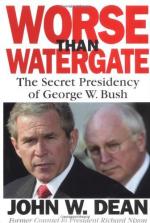
Bush, George W.
(b. July 6, 1946) Forty-third U.S. president (2001–).
Born on July 6, 1946, in New Haven, Connecticut, George W. Bush graduated from Yale and had a successful business career before being elected governor of Texas in 1994 and reelected in 1998. In 2000 he was elected president with a majority of Electoral College votes but lost the popular vote to his opponent Al Gore.
The terrorist attacks of September 11, 2001, changed the course of the Bush presidency. As President Bush remarked in one speech, "in our grief and anger we have found our mission and our moment." President Bush made victory in the war on terrorism and the advance of human freedom the priorities of his administration.
On September 20, 2001, the president gave an address to a joint session of Congress in which he outlined the measures his administration would take to confront the threat of terrorism. Bush announced a series of initiatives,
George W. Bush GETTY IMAGES
including the creation of a new Office of Homeland Security, an executive order freezing the assets of groups and individuals suspected of supporting terrorists, and a plan to improve security in U.S. airports. The first military action in the fight against terrorism successfully removed the Taliban regime in Afghanistan, which had hosted and trained the al-Qaʿida terrorist groups believed responsible for the September 11 attacks.
Internationally, Bush was forced to confront the tenets of his own foreign policy. He was elected with a vision of the United States as a lone superpower taking a unilateral stance in world affairs. But in the wake of September 11, the United States would have to foster relations with other countries to share intelligence information and to track terrorists who seemed to know no country's boundaries. The administration faced a fundamental adjustment, as Secretary of State Colin Powell was the only major cabinet official known for a multilateral approach to foreign policy. National Security Adviser Condoleezza Rice, Secretary of Defense Donald Rumsfeld, and Vice President Dick Cheney were more in the unilateralist camp. The debate over the proper role of the United States in world affairs would continue as the country sought to take a stance in the post–September 11 world.
The conflict between multilateralists and unilateralists over the missile defense system led to the U.S. withdrawal from the 1972 Anti-Ballistic Missile (ABM) Treaty in June 2002, a move that alienated Russian president Vladimir Putin. The Bush administration further espoused a unilateralist position when the president proclaimed North Korea, Iran, and Iraq "an axis of evil" threatening world peace and described the war on terrorism as one of "good versus evil"; he declared that, in this war, nations were either with the United States or against it. In addition, in June 2002 President Bush discussed "preemptive" action against potential enemies as a "new doctrine."
On September 12, 2002, President Bush addressed the United Nations (UN) Security Council, calling for military action against Iraq—which was susupected of maintaining weapons of mass destruction—and stating that the United States would act alone if the council did not comply. Despite President Bush's speech and Secretary Powell's subsequent presentation of evidence regarding Iraq, the continued opposition of France, Germany, and Russia, all permanent members of the Security Council, could not be overcome, even after the UN inspection report released in December indicated that Iraq remained in violation of a UN resolution.
President Bush secured congressional support authorizing the use of force in Iraq in October 2002. He used this support to make his case to the American people in his State of the Union address in January 2003. Then, on March 16, 2003, President Bush issued an ultimatum giving Saddam Hussein and his sons forty-eight hours to leave Iraq or face military action by the United States along with a coalition of allies (most notably the British). Two hours after this deadline passed, Bush announced that the United States was at war with Iraq. This action differed from the Gulf War of 1991 in that Russia, France, and Germany did not participate. Further, there was no UN support and still a great deal of world opposition to the U.S. initiative. The operation officially ceased in May 2003, when President Bush, in what has been dubbed the "Top Gun" moment, landed on an aircraft carrier, proclaimed victory, and announced the end of the military incursion into Iraq. Despite the end of the military action, U.S. forces remained in Iraq, initially to search for Saddam Hussein (who was eventually captured) and weapons of mass destruction, as well as to help stabilize the country.
Bush, George H. W.; Clinton, William Jefferson; Homeland Security; Just-War Debate; 9/11; Powell, Colin; Preemptive War; Terrorism, Fears Of; Weapons of Mass Destruction.
Bibliography
Frum, David. The Right Man: The Surprise Presidency of George W. Bush. New York: Random House, 2003.
Sammon, Bill. Fighting Back: The War on Terrorism from Inside the Bush White House. Washington, D.C.: Regnery, 2002.
Woodward, Bob. Bush at War. New York: Simon and Schuster, 2002.
This is the complete article, containing 821 words
(approx. 3 pages at 300 words per page).