Forgot your password?  

Not What You Meant?  There are 74 definitions for Bear.

Bryant, Paul "Bear" (1913-1983) | Research & Encyclopedia Articles

Print-Friendly   Order the PDF version   Order the RTF version
About 3 pages (814 words)
Bear Bryant Summary


Bryant, Paul "Bear" (1913-1983)

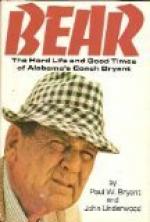
Legend, hero, homespun philosopher, not to mention fashion statement in his houndstooth check hat, Paul "Bear" Bryant has been called a combination of "ham and humble pie." A museum and a football stadium in Tuscaloosa, Alabama, bear his name, and a movie, released in August 1984, called, simply, The Bear, recounts his life. His wife, however, didn't like the film; she couldn't imagine actor Gary Busey playing her husband. "Papa was handsome, " she said, and it was not only she who thought this. Men as well as women agreed that Bear Bryant was a good-looking man. Morris Franks, a writer for the Houston Chronicle, averred, "No Hollywood star ever made a more dramatic entrance. He would jut that granite-like jaw out, turn his camel's hair topcoat collar up and be puffing on a cigarette." The coach evinced a wide-ranging appeal; even his life was a sort of romance. He married his college sweetheart, Mary Harmon, a University of Alabama beauty queen, and for 48 years she remained by his side as best friend, alter ego, and helpmate to the man who had once wrestled a bear in his home state of Arkansas for five bucks and won.

Paul Bryant satisfied America's craving for rags-to-riches and larger-than-life stories. As the eleventh of twelve children, young Paul grew up dirt poor in rural Arkansas, in a place called Morro Bottom that consisted of six houses on Morro Creek. The Bryant home was made up of four small rooms, a big dining room, and a little upstairs area; but Paul thought of it as a plantation, and in the mornings and evenings before and after school, he worked behind the plow. He didn't own a pair of shoes until age 13, but as he affirmed to the boys who played on his teams, "If you believe in yourself and have pride and never quit, you'll be a winner. The price of victory is high but so are the rewards."

Bryant played college football at the University of Alabama on the same team as Don Hudson, who was thought to be the greatest pass-catching end in football in 1934. Nicknamed "Old 43" or "the Other End," Paul may not have been The End, but he became a hero after playing a game against rival Tennessee with a broken leg. When the team doctor removed his cast, Bryant was asked if he thought he could play, and the rest is legend. Number 43 caught an early pass and went for a touchdown. Later in the game, he threw a lateral to a player who scored another. Examining the X-rays of the broken bone, Atlanta sportswriter Ralph McGill, who had initially been doubtful about the injury, acclaimed Bryant's courage, but Bear, in typical big-play fashion, replied, "It was just one little bone."

Bryant went on to head coaching jobs at Maryland, Kentucky, and Texas A & M, before returning to the University of Alabama. When asked to come back to his alma mater, Bryant gave his famous "Mama Called" speech to the fans and players at A & M. He said, "When you were out playing as a kid, say you heard your mother call you. If you thought she just wanted you to do some chores, or come in for supper, you might not answer her. But if you thought she needed

Paul "Bear" BryantPaul "Bear" Bryant
you, you'd be there in a hurry." Bryant served as head coach at the University of Alabama from 1958 to 1982, where he led the Crimson Tide to 323 victories and six national championships. He was named the National Coach of the Year in 1961, 1971, and 1973, and SEC Coach of the Year ten times.

Although he guided the Crimson Tide to thirteen SEC titles, Coach Bryant stood for more than winning; he was a role model. His players maintain that he taught them about life. The coach liked to say that life was God's gift, and a commitment should be made to put something into it.

Paul Bear Bryant never failed in his dedication to the sport he loved. After his death, Bryant's heartfelt eulogies describing what the Bear meant to Alabama, to coaching, and to the players who had been molded by him, led author Mickey Herkowitz to conclude that college football without Bryant would be like New Year's Eve without a clock. It was estimated that some 100,000 mourners lined the interstate from Tuscaloosa to Birmingham, Alabama, to pay their last respects to a small town boy known as Bear. "Thanks for the Memories, Bear," their signs read, "We Love You," and "We'll Miss You." A hero had fallen, but he is remembered. Many feel he can never be replaced.

Further Reading:

Herskowitz, Mickey. The Legend of Bear Bryant. Austin, Texas, Eakin Press, 1993.

Stoddard, Tom. Turnaround: The Untold Story of Bear Bryant's First Year As Head Coach at Alabama. Montgomery, Alabama, Black Belt Press, 1996.

This is the complete article, containing 814 words (approx. 3 pages at 300 words per page).

More Information
  • View Bryant, Paul "Bear" (1913-1983) Study Pack
  • 74 Alternative Definitions
  • Search Results for "Bryant, Paul "Bear" (1913-1983)"
  • More Products on This Subject
    Paul Bryant
    At the time of his retirement in 1982, Paul "Bear" Bryant (1919-1983), legendary coach of the Unive... more


    Ask any question on Bear Bryant and get it answered FAST!
    Answer questions in BookRags Q&A and earn points toward
    discounted or even FREE Study Guides and other BookRags products!
    Learn more about BookRags Q&A
    Copyrights
    Bryant, Paul "Bear" (1913-1983) from St. James Encyclopedia of Popular Culture. ©2005-2006 Thomson Gale, a part of the Thomson Corporation. All rights reserved.

    Join BookRagslearn moreJoin BookRags

    Join BookRagslearn moreJoin BookRags