Forgot your password?  

Not What You Meant?  There are 42 definitions for Norman.

Borlaug, Norman E | Research & Encyclopedia Articles

Print-Friendly   Order the PDF version   Order the RTF version
About 2 pages (536 words)
Norman Borlaug Summary


Norman Borlaug.Norman Borlaug.

Borlaug, Norman E.

American Microbiologist and Agronomist
1914-

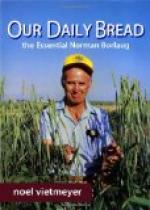
Norman E. Borlaug, perhaps the world's best-known plant breeder, was born on a small farm near Cresco, Iowa, in 1914. He studied plant pathology at the University of Minnesota.

In October 1944 Borlaug began work with the Rockefeller Foundation in Mexico. The foundation had begun a new program in Mexico in 1943 aimed at increasing the agricultural yields of the country. Borlaug's primary scientific achievements were as an applied wheat geneticist with the foundation. He oversaw a highly successful use of Mendelian genetics to create new varieties of wheat.

His work involved the identification of parent varieties with useful traits, such as disease resistance and high yield. He then dusted pollen (male reproductive cells) from the flowers of one variety onto flowers from another variety, from which the stamen had been removed. The transferred pollen cells fertilized the ovules (female reproductive cells) of the recipient flowers. The wheat seeds produced by the female parent were harvested and grown into new plants. Borlaug and his team then identified offspring with desired, novel combinations of traits and used them for further crosses. They released offspring offering high promise and reliability to farmers for commercial cultivation.

Borlaug used a practice considered controversial at the time: shuttle breeding. This involved shuttling breeding stock between two different geographic regions in order to achieve two crossings per year rather than just one. With this technique, he successfully shortened the time needed to obtain new varieties from about ten years to about five years. His shuttle breeding also enabled him to create new wheat varieties that were widely adaptable. In wheat, this wide adaptability was due in part to eliminating day-length sensitivity (photoperiodism) in flowering.

Borlaug's work was of profound significance. Within ten years, he and his team were able to create varieties of wheat well suited to different regions of Mexico, which enabled Mexican wheat farmers to more than triple production, from 365 thousand tons (750 kilograms per hectare) in 1945 to 1.2 million tons (1,370 kilograms per hectare) in 1956. As a result, Mexico stopped importing wheat and began exporting it.

In 1953 wheat varieties bearing semidwarfing genes came to Borlaug from Orville Vogel in Washington State. Vogel had successfully incorporated these genes, obtained from Japanese varieties, into wheats suited to Washington. These varieties responded well to fertilizer and gave substantially higher yields. Borlaug incorporated the semidwarfing genes into his already successful new varieties, which enabled Mexican wheat growers by the early 1960s to obtain over 6,000 kilograms per hectare. In 1963 Borlaug subsequently recommended that India import the new semidwarf varieties, and these plants were equally successful there.

Borlaug's scientific work led to his receipt of the Nobel Peace Prize in 1970. His successes, plus those of his other colleagues in wheat and rice breeding, are often referred to as the Green Revolution. High-yielding varieties of wheat and rice are now grown in all parts of the world. They are very significant in the production of food supplies adequate for the growing human population.

Breeder; Breeding; Grains; Green Revolution; Photoperiodism.

Bibliography

Easterbrook, Gregg. "Forgotten Benefactor of Humanity." Atlantic Monthly 279 (January 1997): 75-82.

Perkins, John H. Geopolitics and the Green Revolution: Wheat, Genes, and the Cold War. New York: Oxford University Press, 1997.

This is the complete article, containing 536 words (approx. 2 pages at 300 words per page).

More Information
  • View Borlaug, Norman E Study Pack
  • 42 Alternative Definitions
  • Search Results for "Borlaug, Norman E"
  • More Products on This Subject
    Norman Ernest Borlaug
    Norman Ernest Borlaug (born 1914) was a biochemist who was awarded the Nobel Peace Prize in 1970 fo... more

    Norman Ernest Borlaug
    Norman Borlaug began his career as a plant pathologist and became a force in international politics... more


    Ask any question on Norman Borlaug and get it answered FAST!
    Answer questions in BookRags Q&A and earn points toward
    discounted or even FREE Study Guides and other BookRags products!
    Learn more about BookRags Q&A
    Copyrights
    Borlaug, Norman E from Macmillan Science Library: Plant Sciences. Copyright © 2001-2006 by Macmillan Reference USA, an imprint of the Gale Group. All rights reserved.

    Join BookRagslearn moreJoin BookRags

    Join BookRagslearn moreJoin BookRags