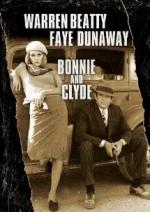
Bonnie and Clyde
Despite their lowly deaths at the hands of Texas Rangers in 1934, Bonnie Parker and Clyde Barrow have enjoyed second lives within America's popular imagination. Gunned down by Texas authorities after a murderous bank-robbing spree, Parker and Barrow occupied a dusty backroom of the national memory until 1967, when a Warner Brothers feature film brought their tale of love, crime, and violence back to the nation's attention. Written by David Newman and Robert Benton and directed by Arthur Penn, Bonnie and Clyde tells a historically based yet heavily stylized story of romance and escalating violence that announced the arrival of a "New American Cinema" obsessed with picaresque crime stories and realistic violence. A major box-office hit, the film and its sympathetic depiction of its outlaw protagonists struck a nerve on both sides of the "generation gap" of the late 1960s, moving some with its portrayal of strong, independent cultural rebels while infuriating others by romanticizing uncommonly vicious criminals.
Inspired by the success of John Toland's book The Dillinger Days (1963), writers Newman and Benton distilled their screenplay from real-life events. In 1930, Bonnie Parker, a twenty-year-old unemployed waitress whose first husband had been jailed, fell in love with Clyde Barrow, a twenty-one-year-old, down-on-his-heels petty thief. In 1934, following Barrow's parole from the Texas state penitentiary, Barrow and Parker and a growing number of accomplices set off on a peripatetic crime spree. Travelling around the countryside in a Ford V-8, the Barrow gang held up filling stations, dry-cleaners, grocery stores, and even banks in ten states in theSouthwest and Midwest. In the process, they murdered—in a particularly wanton manner—between twelve and fifteen innocent people. Bonnie and Clyde's bankrobbing binge came to a violent end in May 1934, when a former Texas Ranger named Frank Hamer, along with three deputies, tricked the outlaws into a fatal ambush along a highway outside Arcadia, Louisiana.
Clyde Barrow and Bonnie Parker.
The Warner Brothers' cinematic retelling of these events creates the appearance of historical accuracy but makes a few revealing additions and embellishments. The film opens when Bonnie Parker (Faye Dunaway), first seen through the bars of her cage-like bed, restlessly peers out of her window, catching Clyde Barrow (Warren Beatty) attempting to steal her mother's car. Young and bored, Bonnie falls for the excitement that Clyde seems to represent. She taunts the insecure Clyde, whose gun and suggestive toothpick hint at a deep insecurity, into robbing the store across the street. Bonnie's quest for adventure and Clyde's masculine overcompensation drive the film, leading the two into an initially fun-filled and adventurous life of petty larceny. Having exchanged poverty and ennui for the excitement of the highway, the criminal couple soon attract accomplices: Clyde's brother Buck (Gene Hackman), his sister-in-law Blanche (Estelle Parsons), and C.W. (Michael J. Pollard), a mechanically adept small-time thief. In a scene modelled after John Dillinger's life, the film makes Bonnie and Clyde into modern-day Robin Hoods. While hiding out in an abandoned farmhouse, Bonnie and Clyde meet its former owner, a farmer who lost it to a bank. They show sympathy for him and even claim to rob banks, as if some kind of social agenda motivated their crimes.
Careening around country roads to lively banjo tunes (performed by Lester Flatt and Earl Scruggs), the gang's encounters with the authorities soon escalate, abruptly turning their light-hearted romp into a growing nightmare. Playful scenes of mad-capped fun segue into brutal, bloody shootouts. One police raid ends with Buck's death, Blanche's capture, and a hair-raising getaway by Bonnie, Clyde, and C.W. At this point, apparently tiring of their rootless escapades, Bonnie and Clyde pine for a more traditional family life, but, tragically, find themselves trapped in a cycle of violent confrontations. Their escape comes when C.W's father agrees to lure Bonnie and Clyde into a trap in return for immunity for his son. To the tune of joyful bluegrass, the colorful outlaws drive blithely into the ambush, innocently unaware of the gory slow-motion deaths that await them.
The incongruous brutality of this dark ending left audiences speechless and set off a national debate on film, violence, and individual responsibility. Magazines such as Newsweek featured Bonnie and Clyde on their covers. Many of the film's themes, it appeared—economic inequality, a younger generation's search for meaning, changing women's roles, celebrity-making, escalation and confrontation, violence—resonated with American audiences struggling to make sense of JFK's assassination, the Vietnam War, the counterculture, student protests, and a mid-1960s explosion of violent crime. Precisely because of Bonnie and Clyde's contemporary relevance, critics such as Bosley Crowther of the New York Times decried its claims to historical authenticity. Clearly they had a point: by transforming homely and heartless desperadoes into glamorous folk heroes and by degrading and demonizing the authorities, especially former Texas Ranger Hamer, whom many considered the real hero of the story, the film did distort the historical record.
But glamorizing rebellion and violence, other critics such as Pauline Kael contended, was not the point of the film, which instead aimed to explore how ordinary people come to embrace reckless attitudes toward violence. The film, they point out, punishes Bonnie and Clyde—and by extension the audience—for their insouciant acceptance of lawbreaking. Interestingly, the popular and critical reception of Bonnie and Clyde appeared to recreate many of the divides it sought to discuss.
Further Reading:
Cott, Nancy F. "Bonnie and Clyde." Past Imperfect: History According to the Movies. Edited by Mark Carnes. New York, Henry Holt and Company, 1995.
Toplin, Robert Brent. "Bonnie and Clyde." History by Hollywood: The Use and Abuse of the American Past. Chicago, University of Illinois Press, 1996.
Trehern, John. The Strange History of Bonnie and Clyde. Jonathan Cape, 1984.
Bono, Sonny
Sonny and Cher
This is the complete article, containing 941 words
(approx. 3 pages at 300 words per page).