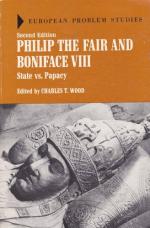
Boniface VIII
BONIFACE VIII (Benedetto Gaetani, c. 1235–1303), pope of the Roman Catholic church (1294–1303). Connected by family relationship not only with the earlier popes Alexander IV and Nicholas III but also with the Orsini and Colonna families, Gaetani studied law at Bologna, worked as a notary at the Curia Romana, served on embassies to France and England, discharged the office of papal legate in France, and by 1291 had become cardinal priest of San Martino. A capable, experienced, and energetic administrator, he was by temperament bold, hardheaded, formidably stubborn, and, at least in his latter years, prone to damaging outbursts of irascibility that some have attributed in part to painful bouts with "the stone." Unfortunately, the juxtaposition of his energetic pontificate with the brief (and chaotic) reign of his predecessor, the devout hermit-pope Celestine V, proved to be a case of the wrong men in a crucial role at the wrong time and in the wrong sequence. The troubles besetting the two pontificates are usually taken to mark the great turning point in the fortunes of the late medieval papacy.
Certainly, the difficulties and disputes that marked the reign of Boniface VIII have served to obscure for posterity the pope's more positive achievements. These were real enough. His reordering of the curial fiscal and administrative system, his publication in 1298 of the Liber sextus, a legal compilation supplementary to the decretals of Gregory IX, his sponsorship in 1300 of the Jubilee Year at Rome, his decisive ruling of that same year on the relationship between the diocesan clergy and the clergy of the mendicant orders, his foundation in 1303 of a studium generale at Rome—all had important, and some of them enduringly positive, consequences. Nonetheless, even such unquestionably positive achievements sometimes generated problems for Boniface. Thus, the increase in financial support and papal prestige stemming from the enormous flow of pilgrims to Rome during the Jubilee may well have bolstered Boniface's self-assurance and encouraged him to be too unyielding in his subsequent dealings with the French king. Similarly, while they were impartially and carefully framed, the measures he introduced to remedy the dissension and disorder in diocesan government spawned by the extensive exemptions and privileges previously granted to the mendicant orders nevertheless succeeded in alienating many of the friars. Yet again, his tightening of the papal fiscal system after the chaos of the previous pontificate, and, within the papal territories, his success in suppressing disorder, enforcing papal control, and extending the property holdings of his Gaetani kin led him into a fatal conflict with the landed interests of the powerful Colonna family.
Problems with Philip IV, king of France, had begun already in 1296 and centered on the right of monarchs to tax the clergy of their kingdoms. Hostilities between Philip and Edward I of England had broken out in 1294, and even in the absence of papal consent the two kings had taken it upon themselves to tax their national churches. Responding to a protest launched by the French Cistercians, Boniface moved in the bull Clericis laicos (February 24, 1296) to proscribe (in the absence of explicit papal permission) all lay taxation of the clergy. In the prevailing climate of opinion, with lay sentiment in the two kingdoms favoring the monarchs and some of the clergy inclining to support them too, threats of excommunication proved to be of no avail. The prestige of the papacy had fallen too low to permit the successful deployment of such spiritual weaponry—so low, indeed, that in 1297, confronted also by the combined opposition in Italy of the Colonna family and the Spiritual Franciscans, Boniface was forced to compromise on the question of taxation and in effect to concede the principle he had attempted to establish.
That concession, however, did not prevent his reacting with great firmness when in 1301 Philip IV arrested Bernard of Saisset, bishop of Pamiers, tried him, threw him into prison, and demanded that the pope endorse those actions. Boniface responded by issuing the bulls Salvator mundi and Ausculta fili, demanding the bishop's release, revoking the taxing privileges earlier granted to the French king, and commanding attendance of the French bishops at a council to be held at Rome in November 1302 in order to consider the condition of religion in France.
Defeated by a Flemish army at Courtral in the summer of 1302, Philip adroitly used the excuse of a national emergency to prohibit attendance of the French bishops at the Roman council. The abortive nature of that assembly, however, did not prevent Boniface from issuing in November 1302 the bull Unam sanctam, a rather derivative document but one culminating with the famous declaration "It is altogether necessary to salvation for every human creature to be subject to the Roman pontiff." Philip's response was even more forceful. Rallying national opinion during the spring of 1303 at a series of assemblies in Paris, and echoing the old Colonna call for convocation of a general council to judge the pope, Philip also authorized his adviser Guillaume de Nogaret to lead an expedition to Italy to seize the person of the pope and bring him back for judgment.
Hence evolved the extraordinary chain of events leading up to the "outrage of Anagni" on September 7, 1303: the attack on the papal palace by Nogaret and Sciarra Colonna, the humiliation of the aged pope, his subsequent rescue by the citizens of Anagni, and his demise soon after at Rome. French pressure by no means ended with his death, and Boniface VIII has since been portrayed as the pope who, while advancing some of the most ambitious claims ever made for the power of the medieval papacy, contrived also to precipitate its decline.
Bibliography
Boase, T. S. R. Boniface VIII. London, 1933.
Digard, G. A. L. Philippe le Bel et le Saint-siège de 1285 à 1304. 2 vols. Paris, 1936.
Digard, G. A. L., et al. Les registres de Boniface VIII. 4 vols. Paris, 1904–1939.
Dupuy, Pierre, ed. and trans. Histoire du différend d'entre le Pape Boniface VIII et Philippe le Bel. Paris, 1655.
Rivière, Jean. Le problème de l'église et de l'état au temps de Philippe le Bel. Paris, 1926.
Scholz, Richard. Die Publizistik zur Zeit Philipps des Schönen und Bonifaz VIII (1903). Reprint, Amsterdam, 1962.
This is the complete article, containing 1,031 words
(approx. 3 pages at 300 words per page).