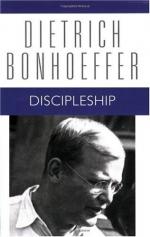
Bonhoeffer, Dietrich
BONHOEFFER, DIETRICH (1906–1945), Lutheran pastor, theologian, and martyr. The sixth of eight children, Bonhoeffer was raised in Berlin in the upper-middle-class family of a leading neurologist. He received his doctorate in theology from the University of Berlin. A student of Adolf von Harnack, Bonhoeffer was deeply influenced by the writings of the young Karl Barth. From 1930 to 1931, he studied at Union Theological Seminary in New York with Reinhold Niebuhr. He then returned to Berlin, teaching theology and becoming student chaplain and youth secretary in the ecumenical movement.
As early as 1933 Bonhoeffer was struggling against the Nazification of the churches and against the persecution of the Jews. Disappointed by the churches' nonaction against Nazism, he accepted a pastorate for Germans in London. However, when the Confessing church (i.e., Christians who resisted Nazi domination) founded its own seminaries, he returned to Germany to prepare candidates for ordination, a task he considered the most fulfilling of his life. As a result of this work, he was forbidden to teach at the University of Berlin. In 1939, after conflicts with the Gestapo, he accepted an invitation to the United States, again to Union Theological Seminary. After four weeks, however, he returned to Germany, convinced he would be ineffectual in the eventual renewal of his nation were he to live elsewhere during its most fateful crisis. He then became an active member of the conspiracy against Hitler. On April 5, 1943, he was imprisoned on suspicion. After the plot to assassinate Hitler failed, Bonhoeffer was hanged (on April 9, 1945), along with five thousand others (including three other members of his family) accused of participating in the resistance.
Bonhoeffer's writings have been widely translated. His early work reflects his search for a concrete theology of revelation. His first dissertation, "Sanctorum Communio," published in Germany in 1930 (also under that title in London, 1963; and as The Communion of Saints, New York, 1963), relates the revelational character of the church to its sociological features. An original statement at the time, it remains evocative. His second dissertation, "Act and Being," was written in 1931 against a background of such opposing philosophies as Kantian transcendentalism and Heideggerian ontology. This work tries to reconcile an existential theological approach with an ontological one. According to Bonhoeffer, these approaches work themselves out in the church, in which revelational contingency and institutional continuity merge.
Turning to the actual life of the church and to criticism of it, Bonhoeffer, in 1937, published his controversial The Cost of Discipleship (New York, 1963). Asserting that "cheap grace is the deadly enemy of our Church," this work, which is based on the sermon on the mount, critiques a Reformation heritage that breaks faith and obedience asunder. In Life Together (New York, 1976), Bonhoeffer's most widely read book, the author considers experiments to renew a kind of monastic life for serving the world. In 1939 Bonhoeffer began to write a theological ethics, the work he intended to be his life-work, but he completed only fragments of it (Ethics, New York, 1965). These fragments reveal Bonhoeffer as moving beyond a situational ethic to a Christ-centered one.
The most influential of Bonhoeffer's posthumous publications has become Letters and Papers from Prison (New York, 1972). Among his daily observations was a vision of a future Christianity ready for "messianic suffering" with Christ in a "nonreligious world." To Bonhoeffer "religion" was a province separated from the whole of life—providing cheap escapism for the individual—and a tool in the hands of the powers that be for continuing domination of dependent subjects. Bonhoeffer was critical of Western Christianity because of its complicity with the Holocaust; his letters reveal his conviction that a life with Christ means "to exist for others." It was his belief in a "religionless Christianity"—that is, a praying church that responds to Christ out of the modern (not sinless) strength of human beings and their decisions—that enabled Bonhoeffer to begin to write a revised theology of "Jesus, the man for others," and to participate in the conspiratorial counteraction against the deadly forces of Hitler.
Bonhoeffer's thought emerged from his cultural heritage of German liberalism. He suffered when he experienced its weakness in the face of Nazism. He rethought this heritage within a Christocentric theology, thus becoming a radical critic of his contemporary church and of contemporary theology because they seemed to him to touch only the insignificant corners of life.
The originality of Bonhoeffer's thought may be summarized in three ways. First, by employing biblical and modern criticism of religion, he gave to theology and piety epochal stress on the idea that the God who is not of this world posits a requisite "this-worldliness" of faith, which is not, however, absorbed by immanentism. Second, Bonhoeffer's words and deeds teach that each generation must discern its own particular means to express its contribution to faith and action. Third, in areas where developments press toward a "confessing church," Bonhoeffer challenges Christians to analyze and to resist ideological syncretism with any zeitgeist, whether the result is a Greek, a Teutonic, or an American Christ.
His influence is worldwide for two reasons. First, his life as theologian and thinker was sealed by martyrdom. Second, Bonhoeffer's legacy has stimulated ecumenism beyond his own national, spiritual, and institutional borders, including influence among Roman Catholics and Jews who see in him a Christian theologian who never cheaply evaded controversial issues.
Bibliography
For a comprehensive listing of primary and secondary literature, see Clifford J. Green's "Bonhoeffer Bibliography: English Language Sources," Union Seminary Quarterly Review (New York) 31 (Summer 1976): 227–260. This admirable work is continually revised and amended in The News Letter of the English Language Section of the International Bonhoeffer Society for Archival Research.
In addition to the works by Bonhoeffer mentioned in the article, see three collections of letters, lectures, and notes titled No Rusty Swords (New York, 1965), The Way to Freedom (New York, 1966), and True Patriotism (New York, 1973). For works about Bonhoeffer, see my Dietrich Bonhoeffer: Theologian, Christian, Contemporary, 3d abr. ed. (New York, 1970); André Dumas's Dietrich Bonhoeffer: Theologian of Reality (New York, 1971); Clifford J. Green's The Sociality of Christ and Humanity: Dietrich Bonhoeffer's Early Theology, 1927–1933 (Missoula, Mont., 1972); and Keith W. Clements's A Patriotism for Today: Dialogue with Dietrich Bonhoeffer (Bristol, 1984).
This is the complete article, containing 1,038 words
(approx. 3 pages at 300 words per page).