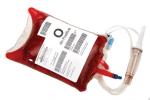
Blood
While the importance of blood to life was understood by primitive peoples, they did not know that blood carries oxygen and food throughout the body, moves waste products, and fights disease. Early societies often ascribed mystical qualities to blood. The Greeks considered blood to be both one of the four essential humors and a carrier of the vital humor blood. For centuries, medical practice based on the findings of the Greek physician Galen advocated bloodletting, or bleeding, because the condition and amount of blood in the body was believed to profoundly affect health.
Nevertheless, the structure and function of blood remained unknown, although it had long been observed that blood standing in a container outside the body settled out into several components: a thick, dark red mass and a pale yellowish fluid (plasma) separated by a thin white layer. William Harvey's revolutionary description of the circulatory system in 1628 focused investigative interest on blood. Some researchers, notably Antoine-Laurent Lavoisier and Richard Lower (1631-1691), studied respiration; Lower demonstrated that contact with air in the lungs turned dark venous blood into bright red arterial blood. Other researchers turned to the newly developed microscope to study the structure of blood. Dutch naturalist Jan Swammerdam discovered the red blood corpuscle in frog's blood in 1658 and observed human blood "particles" in 1662; his findings, however, were not published until 1737. Marcello Malpighi, who discovered the capillaries in 1661, also observed red blood cells in animals. It was the Dutch draper and devoted microscope hobbyist Antoni van Leeuwenhoek who first saw and described human red blood corpuscles in 1673-1674. This, plus his microscopic discoveries of protozoa, bacteria, and spermatozoa, brought Leeuwenhoek world fame.
White blood cells, also called leukocytes, were first observed by Lancisi in 1740. William Hewson (1739-1774), a student of the famed English anatomist and surgeon John Hunter (1728-1793), studied the white cells in detail some 30 years later, managing to distinguish two types. Paul Ehrlich developed a staining method in 1875 that revealed several distinct kinds of leukocytes. In 1883, Elie Metchnikoff, a Russian-born microbiologist working in France, observed simple animal life under a microscope and noticed that certain cells moved immediately to damaged areas. He was soon able to show that white blood corpuscles in higher animals and human beings also attacked and ingested invading bacteria. Metchnikoff called these cells phagocytes.
The third formed objects in the blood, platelets, were first described by Alfred Donné (1801-1901) in 1842 and first studied in detail by Canadian physician William Osler (1849-1919), who reported his findings in 1873-1874. The role of platelets in blood clotting was explained by Giulio Bizzozero (1846-1901) in 1882. The origin of all types of blood cells was shown by Newmann in 1868 to be from parent cells in the bone marrow.
Methods of measuring blood elements were developed in the 1800s, an idea promoted during the 1840s by Gabriel Andral (1797-1876), who introduced the term anemia into medicine. François Magendie suggested a way to count red blood cells that was expanded on and used by Karl Vierordt in 1852 to make an actual count. The next year, Hermann Welcher found a way to count white corpuscles. Georges Hayem (1841-1933) was the first to accurately count platelets. The first practical hemoglobinometer--a blood "counting chamber"--was invented by William Richard Gowers (1845-1915), an English neurologist, in 1878. These counting methods became increasingly important as knowledge about the medical implications of changes in blood composition grew.
While the red blood cells had been discovered in the 1600s, their function was not understood until the mid-1800s. In the early 1850s, two Germans, the physician Otto Funke (1828-1879) and the chemist Justus von Liebig, showed that oxygen combined with a substance, as yet unnamed, in the red blood cell. The German physiological chemist Ernst Hoppe-Seyler isolated and crystallized the substance (a protein) in 1862 and named it hemoglobin. The studies of these men showed that it was hemoglobin that carried oxygen to the body's tissues, giving it up at the cells. Another German chemist, Hans Fischer, worked out the chemical structure of hemin, the active portion of the hemoglobin molecule, and was able to synthesize it in 1929. While researching the causes of anemia, American surgeon George Whipple (1878-1976) discovered that iron, stored in the liver, was essential for the regeneration of hemoglobin; this 1925 discovery made it possible to treat cases of severe anemia (lack of red blood cells) with iron supplements. English biochemist Max Perutz finally worked out the precise atomic arrangement of hemoglobin--which contains 12,000 atoms per molecule--in 1960.
The study of blood cells was advanced in the twentieth century by Dr. Florence Rena Sabin of Johns Hopkins Medical School. Around 1920, she perfected a method of staining living cells so their movements and reactions could be studied. Sabin then used this technique to study the formation of red and white blood cells, which she actually saw occur in the blood vessels of a chick embryo.
Scientists have long known that hemoglobin carries oxygen from the lungs out to the body, then carries carbon dioxide back to the lungs to be exhaled. In 1996, cardiologist Jonathan Stamler and biochemist Joseph Bonaventura showed that hemoglobin plays another role as well, as part of a nitric acid cycle that also aids oxygen delivery.
This is the complete article, containing 872 words
(approx. 3 pages at 300 words per page).