Forgot your password?  


"Barn Burning" | Research & Encyclopedia Articles

Print-Friendly   Order the PDF version   Order the RTF version
William Faulkner
About 10 pages (3,133 words)
Barn Burning Summary

Purchase our "Barn Burning" by William Faulkner


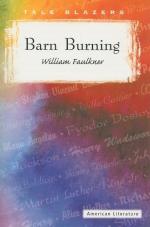
"Barn Burning"

by William Faulkner

Born in 1897, William Faulkner spent his very early years in the country villages of New Albany and Ripley, Mississippi. When he was five years old, his family moved to Oxford and settled there. From the vantage point of the partly restored old mansion his father and mother bought on the town's square, the young Faulkner was able to watch and listen to the parade of farmers that came into this town of little over a thousand citizens. Faulkner later bought his own estate just north of Oxford, where he continued to observe and reflect on the residents of the area. He also made use of his own family history, including ancestors who had led sometimes glorious, sometimes infamous lives in North Carolina and Mississippi. Drawing on these influences, he created many stories and novels set in the fictional county of Yoknapatawpha. Among them is the saga of the Snopes family, beginning with Abner Snopes in the short story, "Barn Burning."

Events in History at the Time the Short Story Takes Place

Reconstruction and beyond. The Civil War virtually destroyed the economy of the South. The resources of even the smallest landowner had, in many cases, been seized by the Confederate government in support of the war effort, and the invading Union army had destroyed land and other property as a means of winning the war.

This page contains 201 words.

Purchase our "Barn Burning" article "Barn Burning" article
Read the rest of this article.
This article contains 3,133 words (approx. 10 pages at 300 words per page).
Ask any question on Barn Burning and get it answered FAST!
Answer questions in BookRags Q&A and earn points toward
discounted or even FREE Study Guides and other BookRags products!
Learn more about BookRags Q&A
Copyrights
"Barn Burning" from Literature and Its Times. ©2008 Thomson Gale, a part of the Thomson Corporation. All rights reserved.