BookRags.com Literature Guides Literature
Guides
Criticism & Essays Criticism &
Essays
Questions & Answers Questions &
Answers
Lesson Plans Lesson
Plans
My Bibliography Periodic Table U.S. Presidents Shakespeare Sonnet Shake-Up
Research Anything:        
History | Encyclopedias | Films | News | Create a Bibliography | More... Login | Register | Help

Not What You Meant?  There are 35 definitions for Atom.

Atom

Print-Friendly  Order the PDF version  Order the RTF version
About 4 pages (1,128 words)
Atom Summary

Bookmark and Share

Atom

Atoms and the subatomic particles that comprise them, are the elementary building blocks of material substances. Although the term atom, derived from the Greek word atomos, meaning indivisible, would seem inappropriate for an entity that, as science has established, is divisible, the word atom still makes sense, because, depending on the context, atoms can still be regarded as indivisible. Namely, once the nucleus is split, the atom loses its identity and subatomic particles. Protons, electrons, neutrons, are all the same—regardless of the type of atom or element—it is only their numbers and unique combinations that make for different atoms. Accordingly, an atom is the smallest particle of an element.

Atoms share many characteristics with other material objects: they can be measured, and they also have mass and weight. Because traditional methods of measuring are difficult to use for atoms and subatomic particles, scientists have created a new unit, the atomic mass unit (amu), which is defined as the one-twelfth of the mass of the average carbon atom.

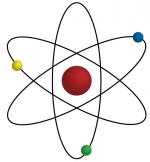
The principal subatomic particles are the protons, neutrons, and the electrons. The nucleus, the atom's core, consists of protons, which are positively charged particles, and neutrons, particles without any charge. Electrons are negatively charged particles with negligible mass that orbit around the nucleus. An electron's mass is so small that it is usually given a 0 amu value in atomic mass units, compared to the value of 1 amu assigned to neutrons and protons (neutrons do carry slightly more mass than protons and neither exactly equals 1 amu—but for purposes of this article the approximate values will suffice). In fact, as the nucleus represents more than 99% of an atom's mass, it is interesting to note that an atom is mostly space. For example, if a hydrogen atom's nucleus were enlarged to the size of a marble, the atom's diameter (to the electron orbit) would be around 0.5 mi (800 m).

At one time, scientists asserted that electrons circled around the nucleus in planet-like orbits. However, because all subatomic particles, including electrons, exhibit wave-like properties, it is makes no sense to conceptualize the movement of electrons as like planetary rotation. Scientists therefore prefer terms like "electron cloud patterns," or "shells," indicating an electron's position and/or pattern of movement in relation to the nucleus. Thus, for example, hydrogen has one electron in its innermost, lowest energy shell (a shell is also an energy level); lithium—with three electrons—has two shells, with inner most, lowest energy shell contains two electrons that one electron exists in a more distant shell or higher potential energy level. The elements exhibit four distinctive shapes of shell—designated s, p, d, and f orbitals.

While subatomic particles are generic and interchangeable, in combination they determine an atom's identity. For example, we know that an atom with a nucleus consisting of one proton must be hydrogen (H). An atom with two protons is always a helium (He) atom. Thus, we see that the key to an atom's identity is to be found in the atom's inner structure. In addition, a electrically balanced chemical element is an instance of atomic electronic equilibrium: for example, in an electrically balanced chemical element, the number of positively charged particles (protons) always equals the number of negatively charged particles (electrons). A loss or gain of electrons results in a net charge and the atom becomes an ion.

Although the number of protons determines the name (type) of atom, each atom may be heavier or lighter depending on the number of neutrons present. Atoms of the same element with different mass (reflecting differing numbers of neutrons) are isotopes.

Research into the atom's nucleus has uncovered a variety of subatomic particles, including quarks and gluons. Considered by some researchers the true building blocks of matter, quarks are the particles that form protons and neutrons. Gluons hold smaller clusters of quarks together.

The atom is best characterized by the laws and terminology or quantum physics. On a larger scale, chemists study reactions, the behavior of elements in interaction, and reactions, such as those leading to the formation of chemical compounds. Such reactions involve the transfer of electrons and/or the sharing of electrons in atomic bonds.

For example, the formation of sodium chloride, also known as table salt, would be impossible without specific changes at a subatomic level. The genesis of sodium chloride (NaCl) starts when a sodium (Na) atom, which has 11 electrons, loses an electron. With 10 electrons, the atom now has one more proton than electrons and thus becomes a net positively charged sodium ion Na+ (a positively charged ion is also known as a cation. Chlorine becomes a negatively charged anion by accepting a free electron to take on a net negative charge. The newly acquired electron goes into the outer shell, also known as the valence shell that already contains seven electrons. The addition of the eighth electron to the chlorine atom's outmost shell fulfills the octet rule and allows the atom—although now a negatively charged chlorine ion (Cl)—to be more stable. The electrical attraction of the sodium cations for the chlorine anion results in an ionic bond to form salt. Crystals of table salt consist of equal numbers of sodium cations and chlorine anions, cation-anion pairs being held together by a force of electrical attraction.

The octet rule is used to describe the attraction of elements toward having, whenever possible, eight valence-shell electrons (four electron pairs) in their outer shell. Because a full outer shell with eight electrons is relatively stable, many atoms lose or gain electrons to obtain an electron configuration like that of the nearest noble gas. Except for helium (with a filled 1s shell), noble gases have eight electrons in their valence shells.

Interestingly, not long after scientists realized that at the level of the nucleus an atom is divisible, transmutation, or the old alchemic dream of turning one substance into another, became a reality. Fission and fusion are tranformative processes that, by altering the nucleus, alter the element. For example, scientists even succeeded in creating gold by bombarding platinum-198 with neutrons to create platinum-199 that then decays to gold-199. Although clearly demonstrating the reality of transmutation, this particular transmutation (a change in the nuclear structure that changes one element into another) is by no means an easy or cheap method of producing gold. Quite the contrary, because platinum, particularly the platinum-199 isotope, is more expensive than gold produced. Regardless, the symbolic value of the experiment is immense, as it shows that the idea, developed by ancient alchemists and philosophers, of material transmutation—accomplished at the nuclear level—does not essentially contradict our understanding of the atom.

Natural transformations also exist—as with the decay of Carbon-14 to nitrogen—accomplished by the nuclear transformation of one Carbon-14 neutron into a proton.

Atomic Mass and Weight; Atomic Number; Atomic Theory; Chemical Bonds and Physical Properties; Chemical Elements

This is the complete article, containing 1,128 words (approx. 4 pages at 300 words per page).

More Information
  • View Atom Study Pack
  • 35 Alternative Definitions
  • Search Results for "Atom"
  • Add This to Your Bibliography
  • More Products on This Subject
    Atom
    smallest unit into which matter can be divided without the release of electrically charged particle... more

    Atom
    Smallest unit into which matter can be divided and still retain the characteristic properties of an... more


    Copyrights
    Atom from World of Earth Science. ©2005-2006 Thomson Gale, a part of the Thomson Corporation. All rights reserved.

    Join BookRagslearn moreJoin BookRags


    About BookRags | Customer Service | Report an Error | Terms of Use | Privacy Policy