
 Print
Print Word
Word PDF
PDF|
This section contains 3,045 words (approx. 11 pages at 300 words per page) |

|
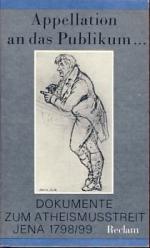
Atheismusstreit, a famous controversy in Germany during the closing years of the eighteenth century, concerned the allegedly subversive philosophical views of Johann Gottlieb Fichte (1762–1814) and of the much less well-known Friedrich C. Forberg (1770–1848).
Fichte, who died as a pillar of respectability, had advanced various radical views in his earlier years, and on the nature and reality of God he never became fully orthodox. In 1793, while living as a private tutor in Zürich, Fichte published two political pamphlets titled "Reclamation of the Freedom of Thought from the Princes of Europe" and "Contributions Designed to Correct the Judgment of the Public on the French Revolution" in which he enthusiastically supported the basic principles of the French Revolution, arguing for free expression of opinion as an inalienable human right and subjecting the privileges of the nobility and the church to trenchant criticism. Fichte was at that time already famous, largely...
|
This section contains 3,045 words (approx. 11 pages at 300 words per page) |
|



