BookRags.com Literature Guides Literature Guides Criticism/Essays Criticism/Essays Biographies Biographies My Bibliography Periodic Table U.S. Presidents Shakespeare Sonnet Shake-Up
Research Anything:        
History | Encyclopedias | Films | News | Create a Bibliography | More... Login | Register | Help

Search "Aristotle"

Contents Navigation
 

Aristotle

Print-Friendly  Order the PDF version  Order the RTF version
About 2 pages (669 words)
Aristotle Summary

Bookmark and Share

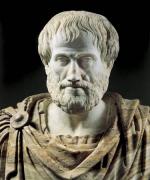
Aristotle. (Corbis Corporation. Reproduced with permission.)Aristotle. (Corbis Corporation. Reproduced with permission.)

Aristotle

384-322 B.C.

Greek Philosopher

By any measure, Aristotle ranks as one of the greatest geniuses who ever lived. He completely reworked Plato's philosophy and established it on a firm systematic basis. He formulated the disciplines of logic, psychology, and embryology, and made important contributions to the study of zoology, medicine, anatomy, physiology, and other life sciences.

Aristotle was born in the coastal town of Stagira in northern Greece. His father Nicomachus was court physician to King Amyntas III of Macedonia. His mother Phaestis was from a prominent family in Chalcis on the Greek island of Euboea. Both parents died when Aristotle was young. He was then raised by his scholarly uncle Proxenus, who gave the boy a wide-ranging education.

At the age of 17, Aristotle enrolled in the Academy of Plato in Athens. He was Plato's student and associate for 20 years, until Plato died in 347 B.C. Disappointed in Speusippus, who followed Plato as head of the Academy, Aristotle accepted the invitation of Hermeias to teach in Assos, Turkey. He married Hermeias's daughter Pythias and they had one daughter, also called Pythias. In 345 B.C. Aristotle moved to the Greekisland of Lesbos where he began a collaboration with Theophrastus (372-287 B.C.), who became his most gifted disciple.

In 343 B.C. King Philip II of Macedonia hired Aristotle to tutor his 13-year-old son Alexander, who was later called Alexander the Great. Aristotle taught Alexander until 340 B.C., when the prince became king. Alexander remained Aristotle's friend and protector, and from 335 B.C. sent him biological specimens from all the lands he conquered.

Sometime between 340 B.C. and 336 B.C. Aristotle moved back to his hometown of Stagira, but he returned to Athens in 335 B.C. After his return, Aristotle founded his own school, the Lyceum, to rival the Academy. Aristotle's school of philosophy is known as Peripatetic, either because he had the habit of strolling around while he lectured (peripatetic is from the Greek verb peripatein meaning "to walk back and forth," or from the fact that his instruction was given in the peripatos, the covered walkway of the gymnasium. His wife Pythias having died, Aristotle had a liaison with a Stagirite woman, Herpyllis. They named their son Nicomachus after Aristotle's father.

When Alexander the Great died in 323 B.C., anti-Macedonian agitation broke out in Athens. Aristotle, who had long-standing Macedonian connections and was a friend of the Macedonian regent of Athens, felt himself in danger. He retired to his mother's family's home on the island of Euboea, reportedly stating that he was leaving Athens to save the Athenians from sinning twice against philosophy (referring to Socrates as the earlier victim). He died of a stomach disease a year later.

Although Aristotle wrote in Greek, we refer to the titles of his books in either Latin or English. No chronological ordering of his works is possible. Less than half of what he wrote survives, and much of it was probably written by students transcribing his lectures.

In the areas of natural science and its philosophy, Aristotle wrote Physics, On Generation and Corruption, On the Sky, Meteorology, and On Breath. His works on zoology include History of Animals, On the Parts of Animals, On the Motion of Animals, On the Generation of Animals, and On the Gait of Animals. Eight of his shorter works on life science (On Sense and Sensible Objects, On Memory and Recollection, On Sleep and Waking, On Dreams, On Divination by Dreams, On Length and Shortness of Life, On Youth and Age, and On Respiration) are collectively called Parva Naturalia.

Aristotle wrote four books about ethics, Nicomachean Ethics, Eudemian Ethics, Magna Moralia, and Politics, and two about the philosophy of art, Rhetoric and Poetics. His six books on logic, Categories, On Interpretation, Prior Analytics, Posterior Analytics, Topics, and On Sophistical Refutations, are collectively called the Organon. His On the Soul is regarded as the world's first book about psychology. His Metaphysics, a work of pure philosophical speculation grounded in empirical observations, has had a tremendous influence on Western philosophy and theology.

This is the complete article, containing 669 words (approx. 2 pages at 300 words per page).

More Information
  • View Aristotle Study Pack
  • Search Results for "Aristotle"
  • Add This to Your Bibliography
  • More Products on This Subject
    Aristotle
    Aristotle was born in 384 B.C. at Stagira, a small coastal town in northern Greece. His father, Nic... more

    Aristotle
    The Greek philosopher and scientist Aristotle (384-322 BC) organized all knowledge of his time into... more


    Copyrights
    Aristotle from Science and Its Times. ©2005-2006 Thomson Gale, a part of the Thomson Corporation. All rights reserved.

    Join BookRagslearn moreJoin BookRags


    About BookRags | Customer Service | Report an Error | Terms of Use | Privacy Policy