BookRags.com Literature Guides Literature
Guides
Criticism & Essays Criticism &
Essays
Questions & Answers Questions &
Answers
Lesson Plans Lesson
Plans
My Bibliography Periodic Table U.S. Presidents Shakespeare Sonnet Shake-Up
Research Anything:        
History | Encyclopedias | Films | News | Create a Bibliography | More... Login | Register | Help

Search "Arcadia"

Contents Navigation
 

Arcadia

Print-Friendly  Order the PDF version  Order the RTF version
About 24 pages (7,239 words)
Arcadia (play) Summary

Bookmark and Share Know this topic well? Help others and get FREE products!

Arcadia

by Tom Stoppard

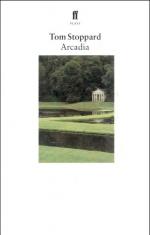
Sir Tom Stoppard, often thought of as the quintessential contemporary English playwright and gentleman, was actually born Tomas Straussler in Zlin, Czechoslovakia, on July 3, 1937. Stoppard took the name of his stepfather, Kenneth Stoppard, a British officer who married his mother after his natural father was killed during the Second World War. In the 1960s Stoppard began to write plays that treat a breathtaking variety of topics, from nuclear physics to metaphysics. Stoppard’s early play, Rosencrantz and Guildenstern Are Dead, which retells the story of Hamlet from the point of view of its most minor characters, was a huge success when it premiered in 1966. Stoppard’s subsequent plays include The Real Inspector Hound (1968), Jumpers (1972), Travesties (1974), The Real Thing (1982), Hapgood (1988), and The Invention of Love (1997). While known primarily as a playwright, Stoppard has also written both fiction (Lord Malquist and Mr. Moon, 1966) and screenplays, including those for Brazil (1986), Empire of the Sun (1987), and Rosencrantz and Guildenstern Are Dead (1991). Most recently, Stoppard won the Best Screenplay Oscar for the 1998 film Shakespeare In Love. Like this film, Stoppard’s Arcadia moves back in time, exploring history to tell us more about our own era.

This is a free page. This page contains 201 words. This article contains 7,239 words (approx. 24 pages at 300 words per page).

Read the rest of this Article with our Arcadia Access Pass.

Ask any question on Arcadia (play) and get it answered FAST!
Answer questions in BookRags Q&A and earn points toward
discounted or even FREE Study Guides and other BookRags products!
Learn more about BookRags Q&A
Copyrights
Arcadia from World Literature and Its Times. ©2008 Thomson Gale, a part of the Thomson Corporation. All rights reserved.


Join BookRagslearn moreJoin BookRags


About BookRags | Customer Service | Report an Error | Terms of Use | Privacy Policy