
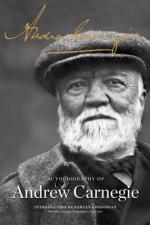
Andrew Carnegie
1835-1919
American Businessman and Philanthropist
Andrew Carnegie embodied the "rags-to-riches" American dream. A poor Scottish immigrant, he amassed great fortune as a financier, then built an empire in the steel industry. Later in life, Carnegie devoted his time to giving away his money and became history's most prominent philanthropist.
Born in Dunfermline, Scotland, on November 25, 1835, Carnegie was the son of a weaver. Like the millions of immigrants pouring into the United States, he and his family searched for a better way of life. They settled in Allegheny, Pennsylvania (now Pittsburgh). With little formal education, Carnegie went to work at age 13 as a bobbin boy in a cotton mill. Later, Carnegie became one of the city's best telegraph operators and advanced through a series of jobs with Western Union.
Carnegie's work with the Pennsylvania Railroad, however, served as his apprenticeship into the business world. Thomas Scott, the superintendent of the railroad, hired Carnegie in 1852 to be his personal telegrapher and secretary. Scott became Carnegie's mentor and friend and taught Carnegie about the world of high finance. Carnegie invested in many companies, including an oil business, a bridge manufacturer, and a railroad sleeping-car company. By 1863, Carnegie earned enough on his investments to declare himself rich.
In 1865, at age 30, Carnegie resigned from the railroad. For the next seven years, Carnegie accumulated great wealth as a stock speculator, but he yearned to start his own company. Recognizing the expanding market for iron and steel, he established the Carnegie Steel Company in 1872.
Carnegie used his knowledge from the railroads in his new venture. His manufacturing strategy revolved around control. He introduced sophisticated cost-accounting systems and kept detailed records of operations, always trying to lower production costs while increasing output. Carnegie used the records to ferret out inefficiencies and find processes that were successful. Carnegie was the first manufacturer to analyze his workers in this manner. Other business leaders adopted Carnegie's management techniques, which served as the foundation of a uniquely American system of manufacturing.
Carnegie was also an early advocate of vertical integration, which led him to acquire the sources of raw materials needed in his mills and sell the finished products. Thus, he controlled the entire production process in the steel industry. Carnegie bought out his raw material suppliers, then acquired a fleet of ships to transport goods. In the 1890s, Carnegie established a sales office and began producing finished goods.
As a result, Carnegie's company became the world's largest steel manufacturer. By 1900, the United States surpassed Great Britain as the leading steel producer. Carnegie's steel served as the backbone of the nation's expanding railroad system and allowed the vast expansion in American cities.
Carnegie solidified his control over the steel industry, then began turning over daily operations to close associates, like Charles M. Schwab and Henry Clay Frick. Carnegie spent more time traveling around the world and interacting with leading scholars and intellectuals.
There was a downside to Carnegie's control, which led to one of the nation's most infamous labor battles. In 1892, union steelworkers in Homestead clashed with Pinkerton strikebreakers hired by Frick. The ensuing gunfight killed one Pinkerton guard and injured many more. The governor of Pennsylvania, at Frick's request, called in the state militia to restore order. Under this protection, strikebreakers were able to smash the union. Many historians believe Carnegie's philanthropy was his way to atone for destroying the union in Homestead.
In 1901, at age 65, Carnegie sold the company to J. P. Morgan for $400 million, making Carnegie the richest man in the world. He devoted the rest of his life to philanthropy and writing. Carnegie believed that the rich have a moral obligation to give back to humanity. He gave numerous personal gifts and established trusts centered primarily on peace studies and education. Carnegie created many philanthropic and educational organizations in the United States, including the Carnegie Corporation of New York, and several more in Europe.
Carnegie had a lifelong interest in establishing free public libraries, which were previously a rarity. He subsequently spent over $56 million to build 2,509 libraries throughout the English-speaking world. During his lifetime, Carnegie gave away over $350 million. He died in Lenox, Massachusetts, on August 11, 1919.
This is the complete article, containing 695 words
(approx. 2 pages at 300 words per page).

