
Forgot your password?  

Not What You Meant?  There are 116 definitions for Mackenzie.

Alexander Mackenzie | Research & Encyclopedia Articles

Print-Friendly   Order the PDF version   Order the RTF version
About 3 pages (739 words)
Alexander Mackenzie Summary


Alexander Mackenzie

1762-1820

Scottish Explorer

Alexander Mackenzie was a trader who explored northwestern Canada in an effort to open up new territories to the fur trade. In his explorations he traced the 1,100-mile (1,770-km) course of the river now named after him from the Great Slave Lake to the Arctic Ocean, near what is now the northern border between Canada and Alaska. He also became the first European explorer to cross the North American continent at its widest point north of Mexico.

Mackenzie was born in Stornoway on the Scottish island of Lewis to a prominent military family. At the age of 12 his family immigrated to New York as part of a large migration of Scots to North America. In New York during the American Revolution his father joined forces loyal to the King of England and died during the revolution. As the war turned against England, the family moved to Montreal, Canada, where Mackenzie began working in the offices of the North West Company, one of the principal trading companies in Canada along with its main competitor, the Hudson's Bay Company.

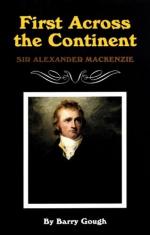
Alexander Mackenzie. (New York Public Library. Reproduced with permission.)Alexander Mackenzie. (New York Public Library. Reproduced with permission.)

In 1784 Mackenzie was offered a partnership in a fur trading form on the condition that he conduct an exploration of the Canadian interior the following year. The exploration was intended to increase the North West Company's knowledge of western Canada's geography and the Native American tribes that inhabited it. The fur trade at the time depended on the familiarity of traders with not only the land in which they trapped and transported animal skins but also the relationships that traders fostered with the tribes that they traded with.

As much a businessman as an explorer, Mackenzie reached Ile à la Crosse in 1785. There he was able to manage a large trading territory stretching from Lake Athabasca to the Great Slave Lake and the upper regions of the Churchill River. Control of the Churchill allowed the Native American trappers to do business with the North West Company rather than having to travel hundreds of miles further down the river to trade with the Hudson's Bay Company at Prince of Wales Fort.

Soon after, with a cousin, Mackenzie established Fort Chipewyan on the shores of Lake Athabasca. It was from Ft. Chipewyan that Mackenzie based his later expeditions down the Mackenzie River and to the Pacific coast.

On June 3, 1789, Mackenzie left Fort Chipewyan with a group of trappers and a member of the Chipewyan tribe named Nestabeck, whom Mackenzie called English Chief. Nestabeck had accompanied the Chipewyan leader Matonabbee from 1770 to 1772 when he guided Samuel Hearne (1745-1792) on his historic overland trip to the Arctic Ocean along the Coppermine River. Traveling down the river the expedition was able to cover about 75 miles (120.7 km) each day, and they reached the river's delta on the Arctic Ocean on July 14, 1789. The group realized they had reached the ocean only by accident when a rising tide swamped their baggage. The return upriver was slower, and they arrived back at Ft. Chipewyan on September 12 of the same year.

On his next expedition, conducted between 1792-93, Mackenzie set out from Fort Chipewyan for the Pacific coast of Canada in hopes of making contact with Russian traders there and fulfilling the goal of establishing a trading route across Canada to the far east, as Spanish and Portuguese explorers had hoped to centuries before. Rather than get rid of the Russian traders, Mackenzie thought they could become intermediaries in the lucrative Pacific trade with China. The expedition traveled west up the Peace River to the Continental Divide. After crossing the mountains the party descended along the Fraser River for 150 miles (241 km) and traveled overland to the Pacific coast of what is now British Columbia. This expedition and the voyage down the Mackenzie River combined to form the first crossing by a European of North America above Mexico.

Before his death in 1820, Mackenzie consulted John Franklin (1786-1847) in preparation for his disastrous expedition to map the northern coast of Canada. Mackenzie stressed the advantage of using members of the local tribes and Inuit as guides for their knowledge of the area. Almost 30 years later Franklin's disappearance in an Arctic naval expedition and the rescue attempts once and for all put to rest the search for a shipping route over the Canada's northern coast that would link the northern Atlantic trade routes with the Pacific.

This is the complete article, containing 739 words (approx. 2 pages at 300 words per page).

More Information
  • View Alexander Mackenzie Study Pack
  • 116 Alternative Definitions
  • Search Results for "Alexander Mackenzie"
  • More Products on This Subject
    Alexander Mackenzie
    Alexander Mackenzie (1822-1892) was a Scottish-born Canadian political leader. He was head of the L... more

    Alexander Mackenzie
    In 1802 the Edinburgh Review called attention to Alexander Mackenzie's Voyages from Montreal, on th... more


    Ask any question on Alexander Mackenzie and get it answered FAST!
    Answer questions in BookRags Q&A and earn points toward
    discounted or even FREE Study Guides and other BookRags products!
    Learn more about BookRags Q&A
    Copyrights
    Alexander Mackenzie from Science and Its Times. ©2005-2006 Thomson Gale, a part of the Thomson Corporation. All rights reserved.

    Join BookRagslearn moreJoin BookRags

    Join BookRagslearn moreJoin BookRags

