BookRags.com Literature Guides Literature
Guides
Criticism & Essays Criticism &
Essays
Questions & Answers Questions &
Answers
Lesson Plans Lesson
Plans
My Bibliography Periodic Table U.S. Presidents Shakespeare Sonnet Shake-Up
Research Anything:        
History | Encyclopedias | Films | News | Create a Bibliography | More... Login | Register | Help


Agee, James

Print-Friendly  Order the PDF version  Order the RTF version
About 5 pages (1,348 words)
James Agee Summary

Bookmark and Share

James Agee

Born November 27, 1909
Knoxville, Tennessee

Died May 16, 1955
New York, New York

Poet, novelist, movie critic,
movie scriptwriter

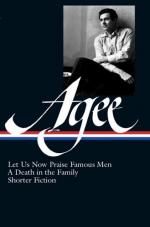
James Agee. Courtesy of the Library of Congress.James Agee. Courtesy of the Library of Congress.

"The talk, in the end, was his great distinguishing feature. He talked his prose, Agee prose.… It rolled just as it reads; but he made it sound natural.…"

Walker Evans, in the introduction to Let Us Now Praise Famous Men

Although a relatively young man when he died at age forty-five, James Agee filled his years with a variety of literary pursuits. He wrote poetry, movie scripts, movie critiques, short prose, and novels. His best-known works are a documentary on white tenant farmers in the Deep South, Let Us Now Praise Famous Men, first published in 1941; a short novel called The Morning Watch, published in 1951; and a longer novel, A Death in the Family, published in 1957, after his death. Agee's literary themes were strongly influenced by his childhood experiences: growing up in a Christian family in Knoxville, Tennessee; suffering the loss of his father; and attending an Episcopalian grammar school, where he was taught various social and religious philosophies.

Early Life

Born and raised in Knoxville, Tennessee, Agee attended grammar school with his sister Emma at Saint Andrews. Saint Andrews was run by members of the Order of the Holy Cross of the Episcopal Church. Agee became friends with Father Flye, a member of the St. Andrews community. For years after leaving Saint Andrews he kept up correspondence with Father Flye, with whom he shared many intellectual interests.

Agee entered the prestigious Phillips Exeter Academy in New Hampshire in the fall of 1925 and told Father Flye that he felt his literary career would take root there. Literature and writing were already Agee's only real love. By 1927 he was editor of the school magazine, the Monthly, and president of the literary club, the Lantern. His attempts at poetry had come to the attention of famous poets such as Robert Frost (1874–1963). With his talent already apparent, Agee was accepted into Harvard University, where his determination to become a writer intensified. However, Agee was often sidetracked by uncertainty, and his spirits would plummet so low that he sometimes considered suicide, only to be in a much improved mood the next day. These emotional extremes would continue throughout his life. Despite this internal conflict, while at Harvard he wrote for, then became president of the Harvard Advocate.

At Fortune Magazine

After graduation from Harvard, Agee went to work for Fortune magazine in 1932 as a reporter and later an editor. While at Fortune Agee enhanced his skills as a writer. He wrote about various businesses and about the Tennessee Valley Authority, a massive New Deal project that brought jobs and electricity to the Southeast. ("New Deal" was the name given to the many programs the administration of President Franklin D. Roosevelt [1882–1945; served 1933–45; see entry] initiated to help America recover from the Depression.)

In 1934 he published his first and only volume of poems, Permit Me Voyage. The poems were highly personal, some written as early as his high school days at Exeter. Agee would continue writing poetry but did not collect it into another book. His poems were eventually published in 1968 in The Collected Poems of James Agee, edited by Robert Fitzgerald.

In 1936, in the middle of the Great Depression, the worst economic crisis in U.S. history, Fortune sent Agee to Alabama. His assignment was to study the Southern farm economy and write a series of documentary articles on the daily life of a sharecropping family. Sharecroppers were farmers who did not own the land they worked. Instead, the landowners supplied them with land and tools and then took part of the crop in exchange. In the 1930s sharecroppers rarely earned more than a few hundred dollars in cash for their crops, and once bills were paid for expenses such as food and medical care, almost nothing was left to live on for the rest of the year. Walker Evans (1903–1975), a photographer on leave from the Resettlement Administration's Historical Section (a federal agency), accompanied Agee. The assignment was to last one month, but Agee and Evans ended up staying two months. In writing and pictures Agee and Evans attempted to honestly relate the lives of three families called the Ricketts, Gudgers, and Woods. Rather than write the articles from the viewpoint that the families were "social problems," Agee showed the great human dignity the families possessed. The material was rejected by Fortune, but Agee continued to work on it, and in 1941 Houghton Mifflin Company published Agee's writing and Evans's photographs in a book titled Let Us Now Praise Famous Men. The book was not well received and sold only a few hundred copies. However, in 1960 Houghton Mifflin reprinted it, and it became an American classic. In Let Us Now Praise Famous Men Agee comes to a realization and understanding of the humanity in himself and in others. In the introduction of Let Us Now Praise Famous Men, Walker Evans describes Agee's total commitment while researching the book and his joy at leaving behind the New York intellectual scene for a while:

He could live inside the subject, with no distractions. Back country poor life wasn't really far from him, actually. He had some of it in his blood, through relatives in Tennessee. Anyway, he was in flight from New York magazine editorial offices, from Greenwich Village social-intellectual evenings, and especially from the whole world of high-minded, well-bred, money-hued culture.... In Alabama he sweated and scratched with submerged glee. The families understood what he was down there to do. He'd explained it, in such a way that they were interested in his work.

Movie Critic

Ever since his childhood, Agee had relished movies. Combining his interest in movies with his writing ability, Agee became a well-known movie critic in the 1940s. He wrote movie critiques for Time magazine from 1941 until 1948. He also wrote a widely read column on movies for the magazine Nation from 1942 to 1948.

Not only a critic, Agee also wrote movie scripts, but none of his original scripts were ever filmed. However, he wrote several screenplays based on novels written by other authors, most notably The African Queen (1951) and The Night of the Hunter (1955). Agee, always vitally involved with how the camera was manipulated during filming, frequently outlined the entire filming process.

Novelist

Agee's best-known novels are The Morning Watch and A Death in the Family. Published in 1951, The Morning Watch is a short novel about a twelve-year-old lad attending an Episcopal school, just as Agee had done as a child. In the book he explores how the child comes to an appreciation and understanding of his real self.

A Death in the Family, published in 1957, two years after Agee's own death, received a 1958 Pulitzer Prize for fiction. It was adapted into the play All the Way Home, which was produced in 1960 and 1961 and received a Pulitzer Prize for drama.

Fame After Death

Having abused his body with both alcohol and tobacco, Agee died of heart failure in 1955. He achieved his greatest fame after death, with the Pulitzer Prize for A Death in the Family and with the successful reprinting of Let Us Now Praise Famous Men. In 1958 his film reviews were collected and published in Agee on Film. His poetry and prose were published in separate collections in 1968, and James Agee: Selected Journalism came out in 1985.

For More Information

Agee, James. Agee on Film: Reviews and Comments. New York, NY: McDowell, Obolensky, 1958.

Agee, James. A Death in the Family. New York, NY: McDowell, Obolensky, 1957.

Agee, James. The Morning Watch. Boston, MA: Houghton Mifflin, 1951.

Agee, James, and Walker Evans. Let Us Now Praise Famous Men. Boston, MA: Houghton Mifflin, 1941.

Ashdown, Paul, ed. James Agee: Selected Journalism. Knoxville, TN: University of Tennessee, 1985.

Fitzgerald, Robert, ed. The Collected Poems of James Agee. Boston, MA: Houghton Mifflin, 1968.

Fitzgerald, Robert, ed. The Collected Short Prose of James Agee. Boston, MA: Houghton Mifflin, 1968.

Phelps, Robert. "James Agee." In The Letters of James Agee to Father Flye. New York, NY: Braziller, 1962.

This is the complete article, containing 1,348 words (approx. 4 pages at 300 words per page).

More Information
  • View Agee, James Study Pack
  • Search Results for "Agee, James"
  • Add This to Your Bibliography
  • More Products on This Subject
    James Agee
    James Rufus Agee, novelist, poet, journalist, film critic, and screenwriter, is best known for a do... more

    James Agee
    The writer James Agee (1909-1955) was a poet, journalist, novelist, and screenwriter. He also was t... more


    Copyrights
    Agee, James from Great Depression and New Deal Reference Library. ©2005-2006 by U•X•L. U•X•L is an imprint of Thomson Gale, a division of Thomson Learning, Inc. All rights reserved.

    Works by Author
    Join BookRagslearn moreJoin BookRags


    About BookRags | Customer Service | Report an Error | Terms of Use | Privacy Policy