Ray Bradbury, born in 1920, sold newspapers after he graduated from high school. At the same time he created his own magazine and wrote short stories. His first money-making story was published when he was 20 years old. Less than a decade after that, a collection of his short stories, Dark Carnival was published. But the 1950's publication of The Martian Chronicles made Bradbury famous as a science fiction writer.
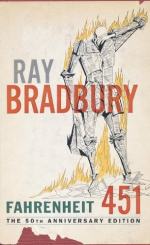
Fahrenheit 451, one of his best-known novels, was published in 1953. It was originally published as a short story, and Bradbury later expanded it to its current length.
Donald Watt says: "On the whole, Fahrenheit 451 comes out as a distinctive contribution to the speculative literature of our times, because in its multiple variations on its fundamental symbol, it demonstrates that dystopian fiction need not exclude the subtlety of poetry."
Bradbury is recognized as a groundbreaker in making science fiction a respected literary genre.
Bradbury has published approximately 500 short stories, novels, plays, and poems since his first story was published. Some of his other works include The Illustrated Man (1951), The Golden Apples of the Sun (1953), Dandelion Wine (1957), Something Wicked This Way Comes (1962), The Machineries of Joy (1964), I Sing the Body Electric! (1969), and The Toynbee Convector (1988).
Bradbury, Ray. Fahrenheit 451. New York: Ballentine Books, 1953.
"Bradbury, Ray." World Literature Criticism: 1500 - Present. James R. Draper, editor. Vol. 1. Detroit: Gale Research, 1992.
Watt, Donald. "Burning Bright: 'Fahrenheit 451' as Symbolic Dystopia." Martin Harry Greenberg and Joseph D. Olander, editors. Taplinger Publishing Company.
View More Summaries on Fahrenheit 451