
BookRags.com Literature Guides Literature
Guides
Criticism & Essays Criticism &
Essays
Questions & Answers Questions &
Answers
Lesson Plans Lesson
Plans
My Bibliography Periodic Table U.S. Presidents Shakespeare Sonnet Shake-Up
Research Anything:        
History | Encyclopedias | Films | News | Create a Bibliography | More... Login | Register | Help

Not What You Meant?  There are 44 definitions for Faber.  Also try: Fahrenheit or Fahrenheit 451 (film).

Student Essay on "Fahrenheit 451": The Dangers of Utopia

Print-Friendly  Order the PDF version  Order the RTF version
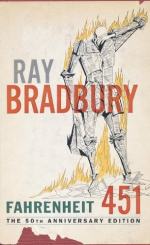
Ray Bradbury
About 4 pages (1,330 words)
Fahrenheit 451 Summary

Bookmark and Share Know this topic well? Help others and get FREE products!

"Fahrenheit 451": The Dangers of Utopia

Summary:   Creating a "utopia" in "Fahrenheit 451" requires the government to take away citizens' rights and freedoms to created the "perfect" society. Ray Bradybury's science-fiction classic parallels the "bookless" society envisioned by the Nazis.


Imagine a society where books are burned into ashes, a world where people do not have time to make love with their partners and a cruel society where people have no rights or freedom to express their thoughts about their past or future. The government of the society lie to its people about books and manipulate them into believe that the books are the only source of unhappiness and destruction within the society. The concept presented in Fahrenheit 451 verifies that such a reality exists within our society. World War II inspired the author, Ray Bradbury to write a utopia novel, Fahrenheit 451. Prior to the tragic events causing the Second World War II, Nazi developed the bookless society, and the Jews rebelled against Nazi, and people lost themselves in new technology. Similarly, in the novel, the author shows how government misleads its people by replacing family love with technology and by creating a censored and bookless society which leads Montag to rebel against the government.

First of all, the government of the society tries hard to keep people busy with technology like screen wall TVs and music because they do not want people to have any spare time to think about either their past or future. Similarly, in 1933, the Nazi used, "psychosurgery and electronic mind-control methods on [people]" (1). Readers can notice the connection between book and WWII and how once again, history has repeated itself and Government controlled the minds of people via technology. In the same way, in the novel, protagonist's wife, Mildred illustrates how she "has lost herself in technology", by all day long "sit[ing] in her parlor and watch[ing] TV on three TV walls set up around her" (Secondary resources 4), not taking care of her husband and not making love with him just like most of the other women in the society. Although she has spare time to read the TV scripts, she has no time to have a conversation with her husband. For example, when Montag stood in the hall for a long time waiting for her response to his question: " 'Do you [Mildred] want to go out tonight for a dinner', asked Montag", but she was too busy, ."..reading her script in the TV parlour room" (Bradbury 54), and takes a while to answer his question. Since people in the society are always unhappy, have complicated problems, do not know how to solve those problems and find a solution for their unhappiness, they cannot sleep without taking sleeping pills. "You took all the pills in your bottle last night. OH, I wouldn't do that because the bottle was empty. " (Bradbury 54-55). As a result, their minds do not work as affective as they should work.. Readers can understand how the government has manipulated its people minds by using different parts of the technology like TV, music, and sleeping pills. Therefore, the characters particularly Mildred demonstrates how government misleads its society by using different elements of the technology.

Secondly, in this imaginary society the fireman job is to burn any resources containing knowledge into ashes because the government want its people to be dim-witted. Without knowledge, the citizens are merely political pawns in an intricate governmental system. The government is afraid that people will know about their past and rebel for their rights, which they feel they deserve; as a result, government manipulates them (people) by creating a bookless and censored society. Similarly, in 1933 before WWII, Nazi student organizations, professors, and librarians made up long lists of books they thought should not be read by Germans; then "On the night of May 10, in most university towns, right-wing students marched in torchlight parades "against the un-German spirit" (2) and they burned all the books which were not written by "Germans." Likewise, in the novel, the government of the society has already destroyed most of books so people cannot find out the significance of books. Later on, this is shown in the book, when Montag asked Faber, "How many copies of Shakespeare and Plato left? None [replied Faber]! How many copies of the Bible are left in this country"" (Bradbury 119-120). Therefore, if people like Mildred cannot read Shakespeare or Bible, then they will forget their memories and they will not be able to think. In addition, Government has changed people's thinking as Montag thinks, "Books make people unhappy and must be destroyed" (3) (use proper MlA format). At this point, Guy Montag does not recognize the true meaning of reading books and the government's propaganda behind his professional, and he finds "a pleasure to burn books" (Secondary resources 2) (use proper MLA format). After burning an old women and her house he starts thinking about the books and their significance in their lives. After this accident, he has started stealing some books from libraries or houses he burns. "I want you to teach me to understand what I read [said Montag]" (Bradbury 127). His life is so changed that he is willing to take any risks by going against the society since he wants to learn how to read books. Hence, people of the society do not even know how to read books; therefore, people are misleading by the government, which is willing to create a censored and bookless society.

Finally, in this utopia novel, Montag starts to rebel against the government by keeping the books in his house and reading them. Similarly, before WWII two Jews friends Franks, and van Daans, rebelled against Nazis by "listen[ing] to the BBC instead of German broadcasts" and "refused to read German books; and also revolted against the restrictions on religion by practicing their own faiths and remaining devout despite persecution" (3). Furthermore, in the novel, Montag's boss Captain Beatty knows all about the books and he tells Montag the truth about the society and about his professional. "He has read a lot and that he knows his enemy. But he despises books and their reader" (Secondary resources 4)(use proper MlA format). Although Beatty has knowledge of how society works and he knows books are useful for the society, he does not have any courage to manipulate people to go against the system or try to change it. Later on, Mildred tells captain Batty about Montag's future plans and how he has started reading books. "Montag shot one continuous pulse of liquid fire on him. Beatty flopped over and at last twisted in on himself." (Bradbury171). Therefore, when the protagonist Montag finds out the truth about his job and books his life changes and he starts rebelling against the government by killing his boss (Captain Beatty). After this incident, Faber the English professor recommends him to leave the city because he thinks that the government will try their best to kill him. Faber also recommends him to join the "Hobo camp" because these people will help him to change the society. Eventually, Montag joins "Hobo camp" and he is assigned ."..to memorize the Biblical book of Ecclesiastes" (Bradbury 211). At the end of the ironic novel, a nuclear bomb dropped in the city and it is destroyed. Hence, the lack of knowledge and finding out the value of books inspired protagonist Montag to rebel against the government. It also demonstrates how government misleads its people to their destruction.

Government will always destroy its people because in order to have a perfect and unique society, citizens have to give up their individual rights and freedom. Therefore, there can never be a balance between the utopia society and rights of the individuals. Political problems inspired the author, Ray Bradbury to write a utopia novel, Fahrenheit 451. The author shows how Montag's, Mildred, and other people of the society lives are affected in many ways because of the government. they have them lost them in technology, and manipulated and forced into hate books. These things lead Montag to rebel against the government. However, in the history, many people have sacrificed their lives for individualism, and freedom.

This is the complete article, containing 1,330 words (approx. 4 pages at 300 words per page).

More Information
  • View "Fahrenheit 451": The Dangers of Utopia Study Pack
  • 44 Alternative Definitions
  • Search Results for ""Fahrenheit 451": The Dangers of Utopia"
  • Add This to Your Bibliography
  • More Products on This Subject
    Fahrenheit 451
    In the book Fahrenheit 451, written by Ray Bradbury, the author has added the effect of parallelism ... more

    Concept of Self-Reliance
    According to Ralph Waldo Emerson's essay "Self-Reliance," "To be great is to be misun... more


    Ask any question on Fahrenheit 451 and get it answered FAST!
    Answer questions in BookRags Q&A and earn points toward
    discounted or even FREE Study Guides and other BookRags products!
    Learn more about BookRags Q&A
    Copyrights
    "Fahrenheit 451": The Dangers of Utopia from BookRags Student Essays. ©2000-2006 by BookRags, Inc. All rights reserved.


    Join BookRagslearn moreJoin BookRags


    About BookRags | Customer Service | Report an Error | Terms of Use | Privacy Policy

