
BookRags.com Literature Guides Literature
Guides
Criticism & Essays Criticism &
Essays
Questions & Answers Questions &
Answers
Lesson Plans Lesson
Plans
My Bibliography Periodic Table U.S. Presidents Shakespeare Sonnet Shake-Up
Research Anything:        
History | Encyclopedias | Films | News | Create a Bibliography | More... Login | Register | Help

Not What You Meant?  There are 10 definitions for Combine.  Also try: One Flew Over the Cuckoo's Nest.

Student Essay on The Transformation of the Jesus Figure

Print-Friendly  Order the PDF version  Order the RTF version
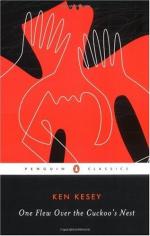
Ken Kesey
About 10 pages (2,980 words)
One Flew Over the Cuckoo's Nest (novel) Summary

Bookmark and Share Know this topic well? Help others and get FREE products!

The Transformation of the Jesus Figure

Summary:   An analysis of the Jesus figure in One Flew Over the Cuckoos Nest (novel), Jesus of Montreal (film) and John Dawe's poem, And a Good Friday was Had By All, the Jesus figure is one of the most commonly identified and utilised elements of Western culture to portray and legitimise Christian ideology.


The Jesus figure is one of the most commonly identified and utilised elements of Western culture to portray and legitimise Christian ideology. The most common way in which this is done is through the appropriation of the Grand Narrative, and in particular through the Jesus figure. In Jesus of Montreal, this legitimisation is achieved through the rejection of the absolute authority of the institution, and by criticising society to ultimately come to a conclusion that upholds basic Christian values. John Dawe's poem, And a Good Friday was Had By All, portrays the Christian message through appropriating the crucifixion of Jesus through the eyes of 'an ordinary man'. The visual and emotive language in particular heightens the audience's appreciation of the injustice and sacrifice of the event, playing a paradox on the title. Finally, in the novel, One Flew Over the Cuckoo's Nest, the Jesus figure is appropriated through an examination of the relationship between faith and the rigidity of the institution, essentially communicating it's authors' sense of the world being hopeless and its people being lost. In this essay, the aforementioned texts will be analysed as appropriations of the Gospels, with a particular focus on film or literary techniques used by the composers.

Arcand's Jesus of Montreal is set in the excessively commercialised and faithless society of Franco-Canada in the 1980s. The main vehicle through which the Gospels are portrayed is through a literal transformation of the Passion Play being the main focus of the plot. The Catholic Church, as represented by the priest, calls upon Daniel to rejuvenate the play, because the church is losing its following. It is at this point that the parallels between the gospels and the film become apparent. In the opening scene, the John the Baptist figure isolates Daniel as "their generations best actor" and the Priest specifically chooses Daniel to rewrite the play. From the opening of the film, Daniel is clearly the 'chosen one' and the appropriation's Jesus figure. As Daniel gather's his disciples it is apparent that they are representative of the figures that Jesus is accounted to have mingled with in the Gospels. The prostitute, the non-believer, the blind-follower and morally void characters are all present. However, in their unorthodox representation of the play, they come to believe in it, becoming shaped by the roles. As such, Daniel becomes a living embodiment of the Holy Trinity spoken of in the Gospels, he is the writer, the director and the lead actor; in another way this can be seen as God, the Holy Spirit and Jesus. In addition, the film forces its audience to question the validity of the church in modern society. The Priest who originally asked that the play be modernised also takes on the role of Judas in Arcand's play, which represents the idea that our modern world rejects the Grand Narrative because of Christian institution's rigidity and inability to modernise. The film rejects the idea of absolute authority and dogma, because the Priest, who is the representation of the Church, is a flawed character, who frequently questions his own ability in his role and breaks his promises of chaste and poverty. Also, he is unable to see that Daniel's representation of the Passion Play is popular, that it is winning the support of its audience, and as such helping the Church. In the final scenes of the film, the audience is confronted with the reality of the Franco-Canadian hospital system, wherein the Catholic / Public hospital refuses to treat him, but the Jewish hospital will treat him. This acts as both a criticism of the governing body and also as a vehicle of irony. In the Gospels, the Jewish people are the masses who desire the death of Jesus, however Arcand portrays the Jewish group as the only people who are willing to help Daniel. This can be read as a direct criticism of the Canadian government in their control of the health system, by contrasting it to a more American and more efficient system.

To emphasise the religious undertones of this piece, film techniques such as symbolic music, camera angles and lighting are used. The film opens with a low-angle view of two choirgirls singing Christian hymns, in the background are the famous stain-glass windows of a French cathedral and the lighting suggests some kind of celestial presence. This opening image is very strong in establishing the films religious agenda. This scene is contrasted starkly with the following scene, which is of a suicide scene in a theatre performance. The dark lighting and frenetic movement of the camera establishes the hopelessness of society and the notion that society has gone wrong. Another example of this is in the first performance of the Passion Play, where the actors are delivering their lines of basic Christian goodness that come directly from Matthew's Gospel. In this scene, Daniel appears to 'transcend' with lighting above him as he enters the scene with his message of love and faith. This contrasts starkly with the high angle shot of the Priest; we look down on him as he stands amongst the followers wearing black in a sea of colour. This is a particularly strong visual representation that Daniel is morally right and that the institution is not flawless. Finally, the most recognisable moment of the film is the death and figurative resurrection of Daniel. In the train station as he is preaching about the apocalypse, cathedral music and high camera angles are used to intensify the emotion and gravity of his words, and also to highlight Daniel's purpose in the film, to be a modernised Jesus-figure. As he dies, the music becomes more apparent and the sound effects disappear, this is particularly effective, as music is more emotionally powerful than realism. As Daniel dies, he falls down and spreads his arms, representing a crucified Jesus. The camera moves away and there appears to be a divine light shining on the collapsed Daniel. This image is repeated in his resurrection scene, where his arms are again splayed out as the crucified Jesus. The imagery, music and camera techniques used in this film contribute largely to the successfulness of Jesus of Montreal as an appropriation of the Jesus figure in the Gospels.

The second text, Dawe's rhyme-less free verse poem, uses a familiar voice in an almost satirical, larrikin manner, which acts to dramatise the ironic truth of the poem's title. The voice of this poem is that of a Roman soldier, that is, the 'average man'. The persona is thus easy for the audience to relate to, and we sympathise with him as he observes that of all the crosses he had done, this Good Friday was the most difficult. The Gospels all speak of Jesus as a lamb, for example, in John 1:29 "the Lamb of God!" that is, the sacrifice of God. In the poem, the voice says that this one's lamblike passivity did not provoke any irrational outbursts that would have justified violence "so you can do your block and take it out on them." He recounts how Silenus and he must do the hammering, despite the unnerving wailing of the women and the dull crushing of his bones. The use of such vivid and dark descriptions acts to draw the reader in and also to establish the mood for the tragedy to follow. The realism and the ordinariness of his language undercut any pious accounts that readers may bring to the text. By crafting this perspective for the reader, Dawe portrays the facts of the crucifixion without rhetoric or pious additions. In particular, being an Australian poet, Dawe's use of a workman's perspective is one that we as Australians are particularly drawn to, and thus through his complaints about duty and hiding of sympathy encourage us to read the work without any assumptions of an underlying agenda.

The majority of the poem is in fact a mental narrative, a series of vivid descriptions that depict the moments before the crucifixion. In essence the first four stanzas establish the mood of darkness and misery, which climax in the last stanza which is the only one which has a real theological purpose. Dawe's character observes that the spread arms on the cross one it is hauled up seem to spread over the men "who had it in for him" and indeed over the whole damned world. The ironic pun put on "damned" lost on the speaker in his colloquialisms is not lost on the audience, as indeed that is the purpose of the Lamb of God's death - to redeemed a damned world. In the Gospels, readers may note a similar testimony in Mark Ch: 15, "Truly this man was the Son of God." The dispassionate, sideline vignette evokes multi-layered connotations, at first it may be shock at the offhand, satirical larrikinism when dealing with such an emotional issue, however a detailed analysis proffers the theological truth that we were all saved on that Good Friday. Finally, that the man's followers were wailing women and a blind man is not incidental, rather it dramatises Jesus' rejection by the establishment, a common theme in all three texts. The oxymoronic "blind man's tears" cliches his irony on that day's incongruities. The point of view in this poem, the workman's unpretentious and unfazed reactions to the day's events touch a familiar chord with an Australian audience. Such familiarity fades as the voice notes how Jesus breaking the predicability offers a revelation when the ordinary becomes a sacrament. Dawe's poem is not just borrowing from the bible; it is dramatising the ironic truth.

In the novel One Flew Over the Cuckoo's Nest, Kesey cleverly uses the schizophrenic character Chief to communicate atmosphere and create the general sense of being "lost" and hopelessness. Society is represented by the patients in a ward of a mental institution, which in turn is representative of the Church as an institution. A particularly distinct driving force behind this novel is Kesey's apparent dissent towards the institution and its control over the masses by making them fear change. The novel opens with the disquieting declaration, "They're out there." These three words sum up the atmosphere of the entire novel: dread, paranoia and mystery. However, by the use of a mentally unstable voice, we are also lead to question the reliability of the recollections. Chief himself ups the ante on this issue by admitting such doubt at the end of the first chapter, "It's still hard for me to have a clear mind thinking on it. But it's the truth even if it didn't happen." This is a very similar to the notion that there is little evidence to justify the Bible's reliability, and forces the audience to question both their faith and ability to believe. However, the wider truth in this is far more telling, people are falling under the control of The Combine, an organisation that manipulates society using drugs and repression. Nurse Ratched, her character summed up by the phonetics of her name, rules over the insular and xenophobic society of the male patients with a strict and sexless code. The one shot at redemption for the patients comes from R.P McMurphy who is not afraid to challenge the status quo and threatens to subvert Ratched's authority. Clearly, he is the Jesus-figure. A major theme in the novel is the importance of laughter, which is echoed in the Gospels with the need for inner peace. The power of laughter resonates throughout the novel. McMurphy's laughter is the first genuine laughter heard on the ward in years. Chief recalls a scene from his childhood when his father and relatives mocked government officials, and he realises how powerful their laughter was: "I forget sometimes what laughter can do." For McMurphy, laughter is a potent defence against society's insanity, and anyone who cannot laugh properly has no chance of surviving. By the end of the fishing trip, McMurphy's disciples are all finally able to participate in real, thunderous laughter, a sign of both their physical and psychological recovery. This parallels the prominent message of peace in the Gospels, that peace and faith in Jesus is the path to redemption.

There are many parallels to the Gospels accounts of Jesus. McMurphy "cures" the sick by inspiring confidence, arguably the lack of which has caused most of the mens' problems. As McMurphy struggles with the rigidity of the daily routine, he leaves the hospital with twelve followers - an allusion to his twelve disciples. Furthermore, this expedition is in fact a fishing trip, which is a parallel to Jesus' testing his disciples' faith in the storm on the lake. Also, Jesus was described in the gospels as a "fisher of men." In the film there is a grotesque Last Supper and Billy Bobbit emerges as the Judas figure, betraying not only McMurphy but also the other patients. This leads to Billy's suicide, and in turn McMurphy's demise as foretold in the Bible. However, literary techniques and symbolism are also used to heighten the dramatic effect of the Christian symbolism. Notably, the allegory of the "peckin' party" is a grotesque and depressing vehicle through which McMurphy 'predicts' his own death:

The flock gets sight of a spot of blood on some chicken and they all go to peckin' at it, see, till they rip the chicken to shreds, blood and bones and feathers. But usually a couple of the flock gets spotted in the fracas, then it's their turn. And a few more gets spots and gets pecked to death, and more and more. Oh, a peckin' party can wipe out the whole flock in a matter of a few hours, buddy, I seen it. A mighty awesome sight. The only way to prevent it--with chickens--is to clip blinders on them. So's they can't see.

The psychedelic imagery of this episode is quite disturbing, but it also becomes evident that this is the way of society. If there is anything that distinguishes a person from the group they will be torn apart by the conservative majority. Also, the idea that only if you blind the people will they be safe from each other is an interesting comment on religion within the society of the 1960s. This abstract prediction from McMurphy is also a direct reference to John Ch: 9 where Jesus says, "I come so that the blind will see and those who see will become blind." Kesey is commenting on the ability of the church to lead the masses to their own deaths, however if they were blind they could be saved. Hence, blind faith is required for the redemption of those who have followed the institution.

Another particularly important scene is when McMurphy is sent to be given electroshock therapy. The tall bony man tells a black boy, "I wash my hands of the whole deal", a direct allusion to Pontius Pilate, who made the same comment about the crucifixion of Christ. McMurphy then proceeds to use particularly Biblical language as he says, "Anointest my head with thy conductant. Shall I get a crown of thorns"" This language intensifies the appreciation of the symbolic crucifixion taking place. In particular, what Kesey achieves is a vivid replication of the gruesome nature of Jesus' death. Through this, Kesey touches a nerve in his Christian audience by challenging the archetypal Grand Narrative and forcing the audience to acknowledge that they have taken part in the human compulsion to single out an individual to blame, shun or ridicule. Kesey is making a comment on society that it is rigid, that it is dysfunctional and that people are generally miserable. Through the grotesque scenes of the novel, such as McMurphy's 'crucifixion' and the Last Supper episode, Kesey portrays the pitiable state of human life, but through the final escape of our narrator, he portrays hope for redemption of sorts without the church.

The Gospel accounts of Jesus' life are amongst the most important archetypes that are treasured within our society, and as a result of this, the notion of a figure sacrificing themselves for the good of the people is an intense and common part of our literary circle. In the three aforementioned texts, the common thread is not only that they are appropriations of the Jesus figure, but also that they comment on the state of society. Due to the importance of the Crucifixion and Resurrection within our society, by placing a Biblical allegory alongside the underlying social comment, the result is far more emotionally intense and pointed statement. In addition, the three texts all include the same theme of the individual against the rigidity of the institution. The timelessness of this idea is highlighted particularly by the more modern texts, as it heightens the comment against the conservatism of society and the result of a power that refuses to change. In particular, the texts use literary of film techniques to emphasise the religious undertones of the respective pieces. In Jesus of Montreal the main techniques used are camera angles, lighting and the use of cathedral music, this accents the episodes of high emotion in the film as well as creating the atmosphere Arcand is trying to portray through his piece. Dawe's And a Good Friday Was Had By All uses imagery and a familiar voice to portray his version of the crucifixion. The darkness evokes the mood and sentiment amongst the reader, whilst the audience is inclined to sympathise with the voice because of the agreeable shift from nonchalance to the beautiful imagery of the women and crying. Finally, in Kesey's novel One Flew Over the Cuckoo's Nest the audience is asked to question the reliability of the amazing story they are being told, but also to question their society and its treatment of extraordinary individuals. The three texts are particularly emotional pieces, and are successful appropriations of the Jesus-figure as well as making pointed comments on the state of society.

This is the complete article, containing 2,980 words (approx. 10 pages at 300 words per page).

More Information
  • View The Transformation of the Jesus Figure Study Pack
  • 10 Alternative Definitions
  • Search Results for "The Transformation of the Jesus Figure"
  • Add This to Your Bibliography
  • More Products on This Subject
    One Flew Over The Cuckoo's Nest: A Sacred Theme
    A Sacred Theme "Jesus Christ was more than man," (Napoleon I). In America, a large portion of the... more

    One Flew Over the Cuckoo's Nest
    In the book One Flew Over The Cuckoo's Nest by Ken Kesey, there are many themes present. The theme ... more


    Ask any question on One Flew Over the Cuckoo's Nest (novel) and get it answered FAST!
    Answer questions in BookRags Q&A and earn points toward
    discounted or even FREE Study Guides and other BookRags products!
    Learn more about BookRags Q&A
    Copyrights
    The Transformation of the Jesus Figure from BookRags Student Essays. ©2000-2006 by BookRags, Inc. All rights reserved.


    Join BookRagslearn moreJoin BookRags


    About BookRags | Customer Service | Report an Error | Terms of Use | Privacy Policy

