
 Print
Print Word
Word PDF
PDF|
This section contains 678 words (approx. 3 pages at 300 words per page) |

|
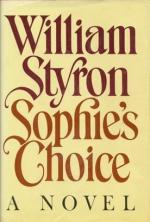
Sophie's Choice is an ambiguous, masterful, and enormously satisfying novel. It reconstructs Auschwitz, the ultimate system of falsehood organized, from the vantage point of the commandant's house, and perceives its litanies to human degradation through an appalling, ordinary focus of daily life. The extermination of the "undesirable" is measured in terms of their clothes piled in the laundry, and the stench of the smoke from the crematorium. Auschwitz is order imposed on quintessential chaos, making chaos efficient. (pp. 90-1)
The novel's credibility depends a great deal on Stingo's lack of it. I was rather nonplussed to find how many reviewers accepted the narrator as Styron himself, and Stingo as the exact replica of his youth. Styron and narrator, Stingo the fictional and Stingo the actual, do have identical histories. They write identical books and develop the same literary reputations. But this is no autobiography; and Styron's balance between...
|
This section contains 678 words (approx. 3 pages at 300 words per page) |
|



