
 Print
Print Word
Word PDF
PDF|
This section contains 602 words (approx. 3 pages at 300 words per page) |

|
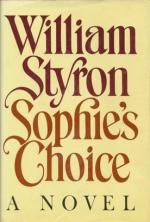
[In Sophie's Choice Styron] tries to address himself simultaneously to some of the fundamental issues of his own life as a writer and to a central dilemma of the moral history of our century. The novel he has shaped to confront these urgent questions is remarkably compelling, eloquent at its best, but not altogether satisfying—perhaps chiefly because the intertwined stories of a writer's coming of age and the meditation on the horrors of the Nazi death camps generate more static than resonance between them. (p. 42)
Styron rather consciously represents himself in his fictional surrogate Stingo as a Young Man from the Provinces: an inexperienced small-town Southerner among Northern urbanites; a youth with a traditional genteel literary education among psychoanalytically minded New York intellectuals; and, above all, a Christian among Jews. The basic structure of the novel, then, is an attempted movement from the periphery to the center...
|
This section contains 602 words (approx. 3 pages at 300 words per page) |
|



