
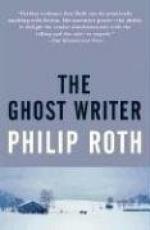
Interpretative fantasies, from Clarissa and Tristram Shandy to Finnegans Wake, Pale Fire, and Gravity's Rainbow, have traditionally concerned themselves with such problems as "validity," "discursivity," and "reality" vs. "textuality," particularly with the status of fictional texts, their origins, ends, and authoritative power. Philip Roth's recent novel, The Ghost Writer, is part of this tradition: it is about origins, and the problems of originality that any serious writer eventually comes to face. It is the kind of novel that forces us to reflect upon the act of writing, in a traditional sense, as an embodiment of "selfhood," and less traditionally, as the place where the "self" may be lost in the warp and woof of the text. In this first-person narration of writer Nathan Zuckerman's quest for a spiritual and aesthetic father, Roth presents us with a parodic reflection upon the notion of "textuality," or language in search of its source of power and authority, orphaned by the very contingencies that make it come into being. Yet the parody here is paradoxical and serious; the novel is a kind of "deconstruction" that mines both customary and revolutionary notions of inspiration, influence, interpretation, authority and literary production. That this comes from one of our finest parodists, whose greatest success thus far is a send-up of the autobiography or confession in Portnoy's Complaint, where ideas of "self" and "generation" are comically considered, is unsurprising. In The Ghost Writer, Roth renews his essential concern with the limits of writing and fiction.
One first notices that The Ghost Writer is filled with "texts." Among these are the forgotten stories of E. I. Lonoff, a Jewish writer who, years ago, escaped civilization for the Thoreauvian respite of his country home in the Berkshires. Lonoff's response to the tedious question, "how do you write?" is a wearying parody of the writing process: "'I turn sentences around. That's my life. I write a sentence and then I turn it around. Then I look at it and I turn it around again. Then I have lunch. Then I come back in and write another sentence.'" There is the text of The Ghost Writer itself, narrated by Nathan Zuckerman, a novelist who bears a ghostly resemblance to the Philip Roth, and who recounts his two-day stay with Lonoff "more than twenty years ago—I was twenty-three, writing and publishing my first short stories, and like many a Bildungsroman hero before me, already contemplating my own massive Bildungsroman."… Within this double textual inversion—Zuckerman the hero of the fiction he will one day write—we are given Zuckerman's reading of Henry James's "The Middle Years" late at night as he examines the riches of Lonoff's study: James's story tells how an author, reading his own latest novel, is led through an encounter with a young admirer to assess the value of his life and art. His imagination stirred by James, by Lonoff, and by a vigorously overhead encounter between Lonoff and the surrogate daughter/lover who lives in the house as a "research assistant," Zuckerman produces another text. He recounts an internalized fiction in which the girl, Amy Bellette, is revealed to be Anne Frank, now in America, in disguise, anguished over the fact that she has had to disown yet another text, her famous diary, so that it might not lose its effectiveness as a dispossessed portrayal of dispossession. And, within this infinite regress of texts, there are dozens of references to other writers—James, Kafka, Hemingway, I. B. Singer, Isaac Babel, Poe, Joyce, Mann, Felix Abravanel (a thinly disguised combination of Norman Mailer and Saul Bellow)—as well as a barrage of fragmentary marginal discourses in The Ghost Writer, including letters, recorded conversations, and Lonoff's underlinings of everything from James to articles on the television industry.
This is a free excerpt of 620 words. There are 2,904 words (approx.
10 pages at 300 words per page) in the full critical essay.
Read the rest of this Criticism with our Roth, Philip (Milton) 1933–: Critical Essay by Patrick O'donnell Access Pass.

