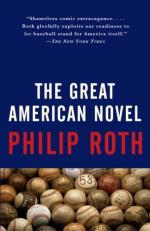
Biography EssayIn 1973, Philip Roth wrote a satirical novel about baseball which he entitled The Great American Novel. The title refers to the parodies of a number of classic American novels in the ...
Read more

The American author Philip Roth (born 1933) used his Jewish upbringing and his college days for the basis of many of his novels and other works.Roth used his experiences in growing up in the Weequahic...
Read more
In 1974, Philip Roth wrote a satirical novel about baseball which he entitled The Great American Novel. The title refers to the parodies of a number of classic American novels in the book, but it al...
Read more
One of the dominant voices of American-Jewish literature during the past two decades, Philip Roth has had an ambivalent, even troubled, response to the Jewishness of his congenial material. He was bor...
Read more
[This entry was updated by S. Lillian Kremer (Kansas State University) from her entry in DLB 173: American Novelists Since World War II, Fifth Series, pp. 202-234.]A major writer of twentieth-century ...
Read more
In the following essay, Greenberg examines the theme of transgression in Philip Roth's work, contending that the author's techniques are uniquely reflective of his relationship with main...
Read more
In the following essay, Krupnick places Roth within the tradition of Jewish-American autobiographies.
Like so many other writers in America, Jewish novelists have often derived inspiration from their ...
Read more
In the following essay, Milowitz examines Roth's treatment of the Holocaust in such works as The Professor of Desire, The Prague Orgy, Deception, Operation Shylock, and others.
Why come to the ...
Read more
In the following essay, Duban explores connections between Roth's story “Eli, the Fanatic” and Nathaniel Hawthorne's “The Minister's Black Veil.”
To be...
Read more
In the following essay, Royal argues that The Counterlife is Roth's most pivotal novel and marks the starting point for his exploration of a postmodern Jewish identity.
Of all Philip Roth...
Read more
In the following essay, Shechner assesses Roth's influence on his own literary outlook.
For all I know, I was the only person in America who was taken by surprise by the double-barreled attack ...
Read more
Critical Essay by Irving Malin
["I Always Wanted You to Admire My Fasting, or, Looking at Kafka"] is a masterful example of comedy. Roth uses cliché and fantasy, movies and spirit...
Read more
Critical Essay by Martin Green
Roth seems to me the most gifted novelist now writing, at least if one puts a stress on tradition in using the word novelist. He translates his intelligence and his feel...
Read more
Critical Essay by Mark Shechner
Whatever else a story may do, its one indispensable element is the imagination's first premise: what if?… What if a petty clerk in Prague should awaken on...
Read more
Critical Essay by Bernard F. Rodgers, Jr.
[As] an artist Roth has placed his faith in Realism, not Judaism…. [From] the wider perspective available when the ethnic emphasis is set aside for a w...
Read more
Critical Essay by Anatole Broyard
"Zuckerman Unbound" is about a young Jewish novelist rather like Philip Roth who has just published a wildly successful book called "Carnovsky,...
Read more
Critical Essay by Isa Kapp
If it were only a matter of wit and intellect, Philip Roth's position as one of the masters of American fiction would be unquestioned. But egged on by some perverse i...
Read more
Critical Essay by Tony Tanner
[Zuckerman Unbound, avowedly a sequel to The Ghost Writer, is] in many ways a repetition which moves to a similar conclusion. It would seem that not only is Roth obsessed...
Read more
Critical Essay by Henry Weil
Is Zuckerman Unbound a success? The answer, unfortunately, is no. What Roth has always done well, he does as scintillatingly as ever. His dialogue rings true; his prose is...
Read more
Critical Essay by Richard Gilman
[In Zuckerman Unbound Roth] doesn't do much with the novel's main theme, which is, or should be, what it's like to be famous. The book veers off f...
Read more
Critical Essay by Edward Rothstein
Nathan Zuckerman, thrice-married son of a foot doctor, is not just a novelist who likes to quote Flaubert and invoke the powers of Art. No, as Philip Roth intimates ...
Read more
Critical Essay by John N. Mcdaniel
Philip Roth is a singular figure in recent American fiction: he is a social realist who adamantly refuses to withdraw from the field, even though he sees around him ...
Read more
Critical Essay by Julian Webb
[The Anatomy Lesson] is the finest, boldest and funniest piece of fiction which Philip Roth has yet produced—and that is quite something to say about the author of...
Read more
Critical Essay by Sanford Pinsker
Prometheus remains the quintessential rebel-hero, the mythological figure who defied Zeus, stole the secret of fire from Hephaestus, and gave it to mankind. For that ...
Read more
Critical Essay by Christopher Lehmann-haupt
In "The Anatomy Lesson"—Philip Roth's rich, satisfyingly complex conclusion to his Zuckerman trilogy, of which "The Ghost...
Read more
Critical Essay by Robert Kiely
Philip Roth, recalling a visit to Prague in 1971, said he was struck by the contrasting situation of writers in a country that is not free and in the United States. Here...
Read more
Critical Essay by Gary Giddins
When Zuckerman Unbound appeared two years ago, it was widely assumed to be Nathan's farewell to his past and Philip Roth's farewell to his alter ego Nathan...
Read more
Critical Essay by Joseph Epstein
There is, as the folks in the head trades might say, a lot of rage in Philip Roth. What, one wonders, is he so angry about? As a writer, he seems to have had a pretty ...
Read more
Critical Essay by Mervyn Jones
It's remarkable that Bellow, Styron, Malamud and Roth have all written novels in which the central character is a writer, more or less closely identifiable with t...
Read more
Critical Essay by John Mellors
Zuckerman in The Anatomy Lesson is a pugnacious rebel and one can well imagine his railing at God and waving a banner saying 'Unfair to Zuckerman!'. Indeed...
Read more
Critical Review by Alfred Kazin
Source: "Tough-minded Mr. Roth," in Contemporaries, Little, Brown and Company, 1962, pp. 258-62.
In the following favorable review of Goodbye, Columbus, w...
Read more
Critical Essay by Judith Paterson Jones and Guinevera A. Nance
Source: "Good Girls and Boys Gone Bad," in Philip Roth, Frederick Ungar Publishing Company, 1981, pp. 9-85.
In the followin...
Read more
Critical Essay by Helge Norman Nilsen
Source: "Love and Identity: Neil Klugman's Quest in Goodbye, Columbus," in English Studies, Vol. 68, No. 1, February, 1987, pp. 79-88.
In the...
Read more
Critical Essay by Jay L. Halio
Source: "Nice Jewish Boys: The Comedy of Goodbye, Columbus and the Early Stories," in Philip Roth Revisited, Twayne Publishers, 1992, pp. 13-36.
In the fol...
Read more
Critical Review by Irving Howe
Source: "The Suburbs of Babylon," in The New Republic, Vol. 140, No. 24, June 15, 1959, pp. 17-18.
In the following review of Goodbye, Columbus, Howe suppo...
Read more
Critical Review by Saul Bellow
Source: "The Swamp of Prosperity," in Commentary, Vol. 28, No. 1, July 1959, pp. 77-9.
In the following excerpted review of Goodbye, Columbus, Bellow annou...
Read more
Critical Review by Leslie Fiedler
Source: "The Image of Newark and the Indignities of Love: Notes on Philip Roth," in Midstream, Vol. V, No. 3, Summer, 1959, pp. 96-9.
In the following a...
Read more
Critical Essay by Joseph C. Landis
Source: "The Sadness of Philip Roth: An Interim Report," in The Massachusetts Review, Vol. III, No. 2, Winter, 1962, pp. 259-68.
In the excerpt below, ...
Read more
Critical Essay by Philip Roth
Source: "Writing about Jews," in Commentary, Vol. 36, No. 6, December, 1963, pp. 446-52.
In the following essay, Roth defends his portrayals of Jewish Ameri...
Read more
Critical Essay by Irving Howe
Source: "Philip Roth Reconsidered," in Commentary, Vol. 54, No. 6, December, 1972, pp. 69-77.
In his reconsideration of Goodbye, Columbus, Howe maintains th...
Read more
Critical Essay by John N. McDaniel
Source: "The Fiction of Philip Roth: An Introduction," in The Fiction of Philip Roth, Haddonfield House, 1974, pp. 1-36.
In the following excerpt, McDa...
Read more