
 Print
Print Word
Word PDF
PDF|
This section contains 450 words (approx. 2 pages at 300 words per page) |

|
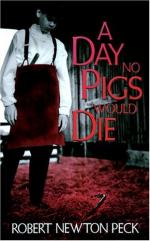
Millie's Boy continues the use of the turn of the century southern Vermont setting that Robert Newton Peck introduced in A Day No Pigs Would Die. The earlier book was a bit of family history; it described isolated rural life in a residually Shaker community, and delivered a heavy dose of ruralism somewhat on the order of descriptions that Homer Croy might have written years ago, but colored by an overly sentimental examination of the boy narrator's psychology. Even worse was the effort to turn the boy into another Huck Finn by giving him cute ways of expressing his incomprehension of the world. Colorfulness via naiveté has its limits and they are as readily detected by young as by old readers.
Millie's Boy, however, is something else. Time and setting are more or less the same as in A Day No Pigs Would Die, but the protagonist is...
|
This section contains 450 words (approx. 2 pages at 300 words per page) |
|



