Robert Peck (born 1928) won critical and popular acclaim for his first novel, A Day No Pigs Would Die (1973). Critics lauded its unsentimental rendering of farm life and the often brutal realities of ...
Read more
Robert Newton Peck's first book, A Day No Pigs Would Die, won several book awards and secured its author a long career in young-adult fiction. This 1972 debut and Peck's subsequent works portray a rur...
Read more
"I am tall, and awkward, and [a] stubborn Vermonter who wears mule-ear boots, a ten-gallon hat and what I like to think of as a country-boy grin."My favorite sport is curling; I play piano honky-tonk ...
Read more

Critical Essay by Zena Sutherland
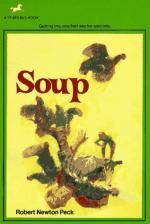
There's a homespun humor and an aura of nostalgia about [the] rural anecdotes [in Soup] but the first try at smoking, the confrontation with an irritated neigh...
Read more
Critical Essay by Richard Adams
[Path of Hunters] is about the lives, food-quests and deaths (as food) of various animals inhabiting an American 'meadow'. In spite of the realistic (even...
Read more
Critical Essay by Edith C. Howley
["Fawn"] might be called an historical vignette, a character study, or a brief tale of the attack by the British on Fort Ticonderoga in 1758…. [I...
Read more
Critical Essay by Eden Ross Lipton
["Wild Cat" is] is a deliberate backlash to the cloying sweetness of most cat books. [It is a] harsh, brutal, detailed moralistic naturalistic [story o...
Read more
Critical Essay by Zena Sutherland
[Fawn] explores the intricacies of divided allegiance during the French and Indian Wars, but it is often tediously repetitive, both in examining Fawn's childho...
Read more
Critical Essay by Sister Alvia
The poems and their introductions [in Bee Tree and Other Stuff] relate the feelings of a boy brought up by plain people to have love for the simple life, the earth, and ...
Read more
Critical Essay by John R. Pancella
The opening paragraphs [of Wild Cat] describe a birth, with the mother licking and eating the membranes, followed by another birth, on dirty rags, of a kitten that i...
Read more
Critical Essay by Lawrence A. Howard
[Hang for Treason] opens with the annihilation of a Vermont farmer's family by the St. Francis Indians and a French advisor; the lone ten-year-old survivor,...
Read more
Critical Essay by Beryl Robinson
The author [of Bee Tree and Other Stuff] celebrates his boyhood on a Vermont farm in a book that explores childhood memories of school, family and friends, hard work, ...
Read more
Critical Essay by Gary Bogart
[Hang for Treason] is a freewheeling yet wholesome (hope that word doesn't put the kiss of death on it) tale of a young boy in Vermont during the Revolution…...
Read more
Critical Essay by Willard M. Wallace
"Rabbits and Redcoats" is Chapter Harrow's account of the part he and his friend Interest Wheelock play in Ethan Allen's capture of For...
Read more
Critical Essay by Mary M. Burns
The idea that romantic notions of war disappear in battle is the unifying theme of an attractively produced historical vignette [Rabbits and Redcoats]…. Viewed f...
Read more
Critical Essay by Jill P. May
Robert Newton Peck's early books brought an understanding of the realities of rural life to many youngsters. His characterization was sharp and his themes of pride...
Read more
Critical Essay by Ruth M. Stein
The main question [in Last Sunday] is whether Sober McGinty will sober up long enough to finish the game for Canby. As twelve-year-old Ruth Babson narrates, we follow h...
Read more
Critical Essay by George Gleason
The supposedly humorous gimmick [in Patooie] is a watermelon-seed spitting contest in the small town of Willetsberg in the 1930's. Standing in for the local see...
Read more
Critical Essay by Mary M. Burns
References to the presidential race between Roosevelt and Landon in 1936 help to establish the setting [of Soup for President] for a nostalgic view of an era when youth...
Read more
Critical Essay by Zena Sutherland
The various incidents of [Trig Sees Red] are concerned with the firing of an elderly traffic policeman and the substitution of a hanging traffic light at Clodsburg...
Read more
Critical Essay by Mary G. Westhuis
An example of the humor that pervades Basket Case …, the following quote introduces two stars from Visigoth movies who attend a school dance: "Tungsten...
Read more
Critical Essay by Emily C. Farnsworth
Peck dedicates Clunie to Professor Wilber Dorsett of Rollins College who inspired the story—then adds:
...
Read more
Critical Essay by Jenny L. Amy
In his usual fashion, Robert Peck has produced a book which will appeal to young adults…. The plot [of Eagle Fur] is well structured, the story fast moving and th...
Read more
Critical Essay by Patricia Lee Gauch
Robert Newton Peck has never been more the consummate storyteller than in ["Clunie", a] book about Clunie Finn, a retarded farm girl caught in a web ...
Read more
Critical Essay by Ethel R. Hardee
[Path of Hunters: Animal Struggle in a Meadow] is a disappointing attempt to draw attention to the beauty and brutality of nature through a series of interrelated dra...
Read more
Critical Essay by Beryl Robinson
Designed to stimulate interest in animal life in one small meadow, the author [of Path of Hunters: Animal Struggle in a Meadow] has described a considerable number of ...
Read more
Critical Essay by Nathaniel Benchley
The search for one's identity—the "Who is the real me?" syndrome—is such a well thumbed theme that it takes a good deal of novel...
Read more
Critical Essay by Zena Sutherland
A first person story, set in rural Vermont at the turn of the century, [Millie's Boy] is told with enough vigor and period detail to compensate for the heavy u...
Read more