
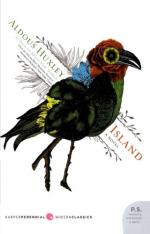
[Island] embodies a collection of the right responses to problems that the brave new world handled badly. But there is even more to the novel than that. Unlike News from Nowhere, Looking Backward, and other positive views of the future, Island can be defended as a reasonably complex novel in which a would-be utopian's attempt at optimism is challenged by the possibility that his characters inhabit a Manichean universe…. Unlike most utopians, Huxley tries to confront several inescapably negative factors in his perfect society, and these ultimately convince him that utopia is not of this world…. I do not wish to discredit the novel's many positive aspects. However, these have been the exclusive focus of all the discussions of the novel to date, while Huxley's insistence that the novel is really about "the precariousness of happiness, the perilous position of any Utopian island in the context of the modern world" has been consistently ignored. One cannot overlook the presence and power of evil in Huxley's last complete novel, nor can one eliminate the author's suspicion that no temporal society can overcome them forever. Although Island is Huxley's conception of a model society, it also serves as the testing ground for some final questions: is utopia really possible? Will the rest of the world tolerate an ideal society, or is the nature of man and the universe too contaminated to leave such perfection alone?
Two misleading assertions generally accompany any discussion of Huxley's utopia. One is that Island is not a novel at all but an extended essay for which Huxley devised only the thinnest of plots. More so than in any other Huxley novel, the plot in Island is supposedly the simple vehicle for the novelist's thoughts. The other insits that Island is both synthesis and palinode. As synthesis it allegedly resolves the philosophical dualisms—real versus ideal, religion versus science, body against mind—that pervade Huxley's previous fiction. By dissolving the opposing elements heretofore at the heart of the ironist's vision, the novel deprives the ironist of his irony. Huxley's triumph as thinker and synthesizer, this argument implies, thus meant defeat for Huxley the creative artist. Island achieves philosophical significance at the cost of aesthetic value. As palinode the novel reportedly abandons Huxley's customary scepticism in favor of optimistic prophecy, thus making utopian speculation feasible once more.
This is a free excerpt of 385 words. There are 1,990 words (approx.
7 pages at 300 words per page) in the full critical essay.
Read the rest of this Criticism with our Huxley, Aldous 1894–1963: Critical Essay by Jerome Meckier Access Pass.

