
 Print
Print Word
Word PDF
PDF|
This section contains 1,328 words (approx. 5 pages at 300 words per page) |

|
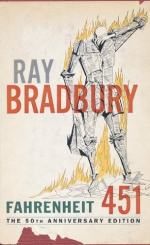
If Bradbury's ladders lead to Mars, whose chronicler he has become, or to the apocalyptic future of Fahrenheit 451, the change is simply one of direction, not of intensity. He is a visionary who writes not of the impediments of science, but of its effects upon man. Fahrenheit 451, after all, is not a novel about the technology of the future, and is only secondarily concerned with censorship or book-burning. In actuality it is the story of Bradbury, disguised as Montag, and his lifelong love affair with books. (p. 169)
"Metaphor" is an important word to Bradbury. He uses it generically to describe a method of comprehending one reality and then expressing that same reality so that the reader will see it with the intensity of the writer. His use of the term, in fact, strongly resembles T. S. Eliot's view of the objective correlative. Bradbury's metaphor in Fahrenheit 451 is the...
|
This section contains 1,328 words (approx. 5 pages at 300 words per page) |
|



