
BookRags.com Literature Guides Literature
Guides
Criticism & Essays Criticism &
Essays
Questions & Answers Questions &
Answers
Lesson Plans Lesson
Plans
My Bibliography Periodic Table U.S. Presidents Shakespeare Sonnet Shake-Up
Research Anything:        
History | Encyclopedias | Films | News | Create a Bibliography | More... Login | Register | Help

Not What You Meant?  There are 30 definitions for Owen.

Robert Owen Biography

Print-Friendly  Order the PDF version  Order the RTF version
About 2 pages (497 words)
Robert Owen Summary

Bookmark and Share Know this topic well? Help others and get FREE products!
Name: Robert Owen
Birth Date: May 14, 1771
Death Date: November 17, 1858
Place of Birth: Newtown, Wales
Place of Death: Newtown, Wales
Nationality: Welsh
Gender: Male
Occupations: social reformer

Encyclopedia of World Biography on Robert Owen

The attempts of the British socialist pioneer Robert Owen (1771-1858) to reconstruct society widely influenced social experimentation and the cooperative movement.

Robert Owen was born in Newtown, Wales, on May 14, 1771, the son of a shopkeeper. Though he left school at the age of 9, he was precocious and learned business principles rapidly in London and Manchester. By 18 he was manager of one of Manchester's largest cotton mills. In 1799 he purchased the mills at New Lanark, Scotland; they became famous for fine work produced with high regard for the well-being of the approximately 2,000 employees, of whom several hundred were poor children.

A reader and thinker, Owen counted among his acquaintances Robert Fulton, Jeremy Bentham, and the poet Samuel Coleridge. Owen's reforms emphasized cleanliness, happiness, liberal schooling without recourse to punishment, and wages in hard times. As his fame spread, he considered implementing ideas that would increasingly negate competitive economics. His attack on religion at a London meeting in 1817 lost him some admirers. His pioneer papers of the time, including "Two Memorials on Behalf of the Working Classes" (1818) and "Report to the County of Lanark" (1821), held that environment determined human development.

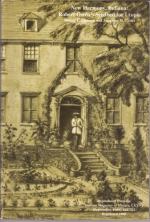
Owen learned of the religious Rapp colony in America at New Harmony, Ind., and determined to prove his principles in action there. In 1825 he purchased New Harmony and drew some 900 individuals to the community for his experiment. Despite the work of talented individuals, New Harmony did not prosper. By 1828 Owen had lost the bulk of his fortune in New Harmony, and he left it.

Following an unsuccessful attempt to institute a comparable experiment in Mexico that year, Owen returned to England to write and lecture. He propagated ideas first developed in 1826 in Book of the New Moral World. A kind, selfless man, he failed to perceive that the industry and responsibility that had made New Lanark great were not present in New Harmony and in other experiments he sponsored. Nevertheless, his views created theoretical bases for developing socialist and cooperative thought.

In The Crisis (1832) Owen advocated exchanging commodities for labor rather than money to relieve unemployment. The Equitable Labour Exchange founded that year failed but led to the Chartist and Rochdale movements. Labor unrest further fed on Owenite tenets, and in 1833 the Grand National Consolidated Trades Union was formed. It rallied half a million workers and fostered such new tactics as the general strike but fell apart within a few months, owing to opposition by employers and the government.

Owen continued to write and propagandize. Such experiments as Harmony Hall, in Hampshire, England (1839-45), derived from his theories. But new revolutionary forces and leaders put him out of the main current. His conversion to spiritualism in 1854 and his New Existence of Man upon the Earth (1854-1855) seemed to him a broadening of reality, rather than a retreat. His Autobiography (1857-1858) is one of the great documents of early socialist experience. He died in Newtown, Wales, on Nov. 17, 1858.

This is the complete article, containing 497 words (approx. 2 pages at 300 words per page).

View More Summaries on Robert Owen
More Information
  • View Robert Owen Study Pack
  • 30 Alternative Definitions
  • Search Results for "Robert Owen"
  • Add This to Your Bibliography
  • More Products on This Subject
    Robert Owen
    Robert Owen is considered one of the original socialists. His ideas about cooperation and workers' ... more

    Robert Owen
    Robert Owen is best known as the founder of British socialism, as an ardent critic of inhumane indu... more


    Ask any question on Robert Owen and get it answered FAST!
    Answer questions in BookRags Q&A and earn points toward
    discounted or even FREE Study Guides and other BookRags products!
    Learn more about BookRags Q&A
    Copyrights
    Robert Owen from Encyclopedia of World Biography. ©2005-2006 Thomson Gale, a part of the Thomson Corporation. All rights reserved.

    Join BookRagslearn moreJoin BookRags


    About BookRags | Customer Service | Report an Error | Terms of Use | Privacy Policy

