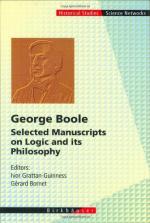
George Boole was the founder of the modern science of mathematical logic. He devised a system of binary algebra that today has broad applications in the design of computer circuits and telephone switching. He also made significant contributions to probability theory, the field of differential equations, and the calculus of finite differences.
George Boole was born in Lincoln, England, on November 2, 1815, into what was regarded at the time as a lower class family. His father, a tradesman, encouraged Boole to obtain an education in the classics, believing this might elevate him to a higher social rank. Because Latin and Greek were not offered at the National Schools, the only formal educational institutions then available for boys of Boole's social status, he studied the ancient languages on his own. At the age of 12, Boole made a translation of a Latin ode by Horace, which his father submitted for publication in a local newspaper. When the translation appeared in print, a local Latin scholar argued that no 12-year-old could have been capable of such an accomplishment, and Boole was falsely accused of plagiarism. In addition to the classics, he was encouraged to learn mathematics. Boole's father had a personal interest in the subject and passed on what rudimentary knowledge he could from his own private study. Boole took a job as an assistant schoolteacher when he was 16, in order to help support his parents. He also began, in his spare time, to study for the clergy. In 1835, his parents' poverty worsened and Boole chose to abandon his religious pursuits. Boole opened his own elementary school and, in the course of preparing his students in mathematics, found that the available textbooks were inadequate. As he searched for better teaching materials, Boole began reading the classical mathematical works of the 17th and 18th century masters, developing an interest in algebra and calculus, and was influenced by the works of Isaac Newton andPierre Laplace. He made a special study of Mecanique analytique, in which the author and French mathematician Joseph-Louis Lagrange set forth a purely analytical calculus of variations.
By the late 1830s, Boole was ready to make original contributions in the field of analysis. He established contact with Duncan Gregory, a Scottish mathematician who edited the newly founded Cambridge Mathematical Journal. This relationship was significant because, uncredentialed and lacking membership in a learned society, Boole had few options for presenting his ideas to a mathematical audience. Gregory, impressed with Boole's style and originality, began publishing his work. In 1841 Boole wrote a paper on the theory of algebraic invariants which greatly extended the work of Lagrange. On the basis of this paper, Boole is often credited with the discovery of invariants, a construct that has application in theoretical physics. In 1844 Boole published a paper on the calculus of operatorsin the Philosophical Transactions of the Royal Society. For his original contribution to this field, the Royal Society of London awarded him a gold medal. This honor led to Boole's correspondence with many of the prominent British mathematicians of his day. He was encouraged to take courses at Cambridge University, but finances never allowed. Boole continued teaching at his elementary school until 1849, when, owing to the reputation he had established, he was offered a university post. Despite his lack of formal training, Boole was welcomed as the Chair of Mathematics at the newly established Queens College, Cork, in Ireland. His professorship marked the end of his economic struggles, and allowed him to devote more time to his interests in both calculus and symbolic logic.
Boole's reputation as a prominent mathematician was secured by his work on the subject of mathematical logic. In 1847 he published a groundbreaking pamphlet, The Mathematical Analysis of Logic, in which he argued that logic was more closely allied with mathematics than philosophy. The pamphlet was written in reaction to an ongoing dispute between William Hamilton, professor of logic and metaphysics at the University of Edinburgh, and Augustus De Morgan, a logician and professor of mathematics at the University of London. Hamilton believed that the study of mathematics was a useless exercise, and that de Morgan would be a better philosopher if he were less of a mathematician. De Morgan, already recognized in Britain for his contributions to the study of logic, was also known for his satirical wit. He apparently made short-order of Hamilton's arguments and was in no need of additional aid from Boole. Nonetheless, Boole's pamphlet, which established that mathematical rules could be applied to logic, won de Morgan's admiration.
In 1854 Boole wrote An Investigation of the Laws of Thought,in which he greatly developed his ideas about logic. He reduced logical relationships to simple statements of equality, inequality, inclusion and exclusion, and expressed these statements symbolically, using a two digit or binary code. Boole then devised algebraic rules that governed the logical relationships. This bridge between mathematics and logic came to be known as Boolean algebra.
In the years following the publication of his treatise on logic, Boole turned his attention to calculusand differential equations. He wrote a standard textbook, Treatise on Differential Equations, in 1859, in which he investigated partial differential equations. Boole also advanced criteria for distinguishing between singular solutions and particular solutions of differential equations of the first order. In 1860 he published another textbook, Treatise on the Calculus of Finite Differences.Boole's two textbooks were in wide use at universities for many decades after his death.
In 1855 Boole married Mary Everest (Boole), niece of Sir George Everest, a Professor of Greek at Queen's College and the man for whom the world's highest mountain is named. They had five daughters, including the mathematician Alicia Boole Stott. Boole died prematurely at the age of 49. Attempting to get to a class on time, he walked two miles through a drenching rain. Soon after lecturing in his wet clothes he contracted pneumonia. The story is told that his wife, believing the remedy for an illness ought to bear resemblance to its cause, put him to bed and doused him with buckets of cold water. Boole died in Ballintemple on December 8, 1864, and is buried at St. Michael's Church in Blackrock, County Cork, Ireland.
Boole was honored in his lifetime with degrees from the universities of Dublin and Oxford. He was elected a fellow of the Royal Society of London in 1857. He was also made a member of the Royal Irish Academy. Although for many years the ideas of Boole's symbolic logicwere regarded mostly as philosophical curiosities, they eventually found important practical application. Much of modern computer processing is based on the binary system of Boolean algebra, as is the design of computer circuitry and telephone switching equipment.
This is the complete article, containing 1,112 words
(approx. 4 pages at 300 words per page).