|

Search "The Grass Harp"
|

|
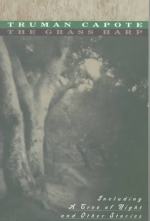
The Grass Harp by Truman Capote | |
|
About 182 pages (54,645 words) in 11 products |
|


| Name: |
Truman Capote | | Birth Date: |
September 30, 1924 | | Death Date: |
August 25, 1984 | | Place of Birth: |
New Orleans, Louisiana, United States | | Place of Death: |
Los Angeles, California, United States | | Nationality: |
American | | Gender: |
Male | | Occupations: |
author |
summary from source:

Biography of Truman Capote
472 words, approx. 1.6 pages
 A master at blending fact and fiction, both in his writing and in his personal life, Truman Capote was born on September 30, 1924, in New Orleans, Louisiana. His childhood was difficult due his parents' divorce, his mother's decision to send Truman to li...
summary from source:

Biography of Truman Capote
12687 words, approx. 42.3 pages
 When Truman Capote died on 25 August 1984, a month short of his sixtieth birthday, he had few mourners. In a letter to Helen S. Garson after the 1986 publication of Answered Prayers, Capote's longtime editor, Joe Fox, stated he was happy not to have to w...
summary from source:

Biography of Truman Capote
8121 words, approx. 27.1 pages
 Truman Capote (1924-1984) was one the most famous and controversial figures in contemporary American literature. The ornate style and dark psychological themes of his early fiction caused reviewers to categorize him as a Southern Gothic writer. However,...


Encyclopedia and Summary Information
summary from source:

The Grass Harp Information
818 words, approx. 3 pages
 The Grass Harp is a 1951 novel by Truman Capote. The story focuses on an orphaned boy and two elderly ladies who observe life from a tree. They eventually leave their temporary retreat to make amends with each other and other members of society. The...


Literary Criticism
summary from source:

Critical Essay by Richard Hayes
277 words, approx. 1 pages
 There is pleasure in reporting how very fine [The Grass Harp] is, how admirably and even brilliantly accomplished—instinct with vitality and humor and a tenderness which never curdles into sentimentality. One's pleasure in this case has little to do with literary actualities: it rises, rather, from satisfaction at the confirmation of a talent…. The Grass Harp represents [Capote's] first serious experiment in major fiction. (p. 73)
summary from source:

Critical Essay by Eric Bentley
256 words, approx. 1 pages
 It is true that the arboreal fable of The Grass Harp is meant to symbolize an escape from humdrum reality, that Mr. Capote's real theme is the search for one's real self, and that such a theme is not to be stigmatized as trite merely because it is traditional. It has the effect of triteness in this play because it is in no way rendered active by Mr. Capote's art: when he has finished it still belongs to tradition, he has in no way made it his own. When his people speak we hear only othe...
summary from source:

Critical Essay by Granville Hicks
206 words, approx. 1 pages
 In so far as it is a story of youth and loneliness, Truman Capote's second novel resembles his first, but there are noteworthy differences in quality. "The Grass Harp" is less contrived than "Other Voices, Other Rooms," not so elaborately furnished, not so densely metaphorical. Although much of it is not quite literally credible, it is extravagant, rather than bizarre, and there are no such Gothic touches as the red tennis balls and the hanging mule. More of the writing is...


|
The Grass Harp by Truman Capote | |
|
About 182 pages (54,645 words) in 11 products |
|
|
|


|