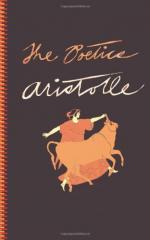
Everything you need to understand or teach
Poetics by Aristotle.
Products may contain comprehensive summaries, analysis, notes, articles, essays,
lesson plans and more. See below for details on what is included.
Biography EssayAristotle was born in 384 B.C. at Stagira, a small coastal town in northern Greece. His father, Nicomachus, was a physician to the Macedonian ruler Amyntas II. His mother was Phaestis, ...
Read more
The Greek philosopher and scientist Aristotle (384-322 BC) organized all knowledge of his time into a coherent whole which served as the basis for much of the science and philosophy of Hellenistic and...
Read more
While he is highly regarded as a philosopher and father of logic and reasoning, Aristotle is also known for accomplishments in and contributions to other sciences. Throughout his life, he wrote severa...
Read more
While he is highly regarded as a philosopher and father of logic and reasoning, Aristotle is also known for accomplishments in and contributions to other sciences. Throughout his life, he wrote severa...
Read more
As a formidable student, researcher, teacher, and philosopher in virtually all scientific disciplines, Aristotle had a profound impact on the way science and mathematics is practiced and investigated ...
Read more
While he is highly regarded as a philosopher and father of logic and reasoning, Aristotle is also known for accomplishments in and contributions to other sciences. Throughout his life, he wrote severa...
Read more
Aristotle is counted among the greatest of philosophers for his inquiries into almost every branch of knowledge, including ethics, aesthetics, physics, and biology. In particular, his empirical resear...
Read more
While he is highly regarded as a philosopher and father of logic and reasoning, Aristotle is also known for accomplishments in and contributions to other sciences. Throughout his life, he wrote severa...
Read more
Aristotle was born in 384 B.C. at Stagira, a small coastal town in northern Greece. His father, Nicomachus, was a physician to the Macedonian ruler Amyntas II. His mother was Phaestis, a descendant of...
Read more
In the following essay, Draper studies the way in which the understanding of "mimesis," or imitation (as discussed by Aristotle in Poetics), changed over the course of the eighteenth cen...
Read more
In the following essay, Gulley studies Aristotle's use of the term "imitation" and the relationship between that which the dramatic or literary artist represents and that which is...
Read more
In the following essay, Packer argues that the 'formal and psychological requirements of good tragedy "outlined by Aristotle in Poetics cannot be thought of as a definition of tragedy. R...
Read more
In the following essay, Roberts contends that in discussing the natural limit of plot length, Aristotle conceived of some action as taking place "outside" of the drama's plot. Rob...
Read more
In the following essay, Brett examines the concept of catharsis, or purgation, which Aristotle discusses in Poetics. Brett suggests that while Aristotle's definition of tragedy omits direct ref...
Read more
In this brief overview, Cooper reviews such textual issues as the date of composition of Poetics and the possible sources on which Aristotle drew to write the treatise. Cooper also discusses the struc...
Read more
In the following essay, Baldwin offers a general overview of Aristotle's Poetics, discussing in particular the role of imitation in Aristotle's poetic theory.
Veneration of Aristotle has...
Read more
In the following essay, Herrick traces the influence of Aristotle's Poetics on English literature from Roger Bacon's (c. 1214-1294) mention of the treatise in his works through the possi...
Read more
In the following essay, written in 1956, House maintains that Aristotle's views regarding the importance of plot in tragedy actually reveal his "attempt to guarantee the individuality of...
Read more
In the following essay, written in 1956, House analyzes the features of dramatic characters which Aristotle discusses in Poetics. In particular, House focuses on the tragic hero and on the concept of ...
Read more
In the following essay, Berns reviews several aspects of Aristotle's Poetics which he believes have been misunderstood. He examines what Aristotle meant by the term "imitation"; t...
Read more
In the following essay, Lord examines Aristotle's elevation of plot above all other elements of tragedy and argues that he does indeed assert that all aspects of character, including the concep...
Read more
Teaching Poetics
All teaching products sold separately.
Poetics Lesson Plans contain 145 pages of teaching material, including: