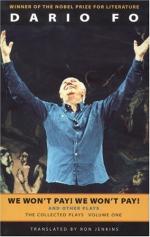
Italian playwright Dario Fo (born 1926) is known for his satirical and often controversial works. He was awarded the 1997 Nobel Prize in Literature.Although he has been hailed by critics worldwide for...
Read more
In the following, Fo discusses influences on his work in the theater.
At the Rai Studios in Milan, Dario Fo is just finishing the editing of a series of shows to be aired in the Spring of 1978. We are...
Read more
In the following essay, Wing contends: "By presenting [in Mistero Buffo a kind of fragmented iconicity—fragments of characters, fragments of actions and interactions—Fo has shaped...
Read more
In the following essay, Wing maintains that the form of Accidental Death of an Anarchist reinforces its content. The provisional, ever-changing nature of the play, she argues, demonstrates that the ...
Read more
Rame is Fo's wife and collaborator. In the essay below, which was written in 1975, she recalls their early years working together.
There are many people who seem to think—perhaps because...
Read more
In the following essay, Cowan traces Fo's career and delineates the essential characteristics of his works.
In Western Europe, where Brecht's plays have by now become standard fare for b...
Read more
In the following, Schechter emphasizes the political satire in Fo's work.
Dario Fo received official recognition as a subversive comedian in May 1980, when the United States government refused ...
Read more
In this essay, Jenkins argues that "Fo has developed a modern style of epic performance that speaks to his audience with the immediacy of a newspaper editorial, shifts perspectives with the flu...
Read more
In the essay below, D'Aponte assesses the impact Fo has had on American theater.
Clowns are grotesque blasphemers against all our pieties. That's why we need them. They're our al...
Read more
In the essay below, Hood provides a broad survey of Fo's career.
Dario Fo represents a tradition in Italian theatre that gave the world comic figures like Pulcinella and Arlecchino. The lineage...
Read more
In this essay, Farrell discusses the difficulties inherent in attempting to translate Fo's works. Fo, he states, "requires more than standard translation techniques. He requires deep und...
Read more
Mitchell offers a detailed examination of Mistero Buffo. This work, he declares, "and its many offshoots, together with the countless improvised routines and sketches on topical events which Fo...
Read more
Critical Essay by Variety
In these wide open, permissive, seen and heard it all before '80s, is it possible for a play to be "a direct political intervention" in or a "radi...
Read more
Critical Essay by Frank Rich
The plays [which make up "Orgasmo Adulto Escapes from the Zoo"] are uncompromising in their convictions. And yet we sit … [in the theater] with the si...
Read more
Critical Essay by Mel Gussow
As playwright monologist and public personality, Dario Fo is an impertinent iconoclast, provoking officialdom at the same time that he is tickling his audience. Among cont...
Read more
Critical Essay by John Simon
I am not very fond of one-man plays. Or one-woman, one-trained-seal, one-anything plays…. Generally speaking, there is something demoralizing about going to theatri...
Read more
Critical Essay by Robert Brustein
Dario Fo is a high-spirited Italian dramatist in an Aristophanic tradition who writes plays as if Karl Marx and Groucho Marx were contending for his soul. The result ...
Read more
Critical Essay by J. W. Lambert
I went off to see Einer fur alle, alle fur einen … with no great hopes…. But Signor Fo, however dubious his political common-sense has been in the past, t...
Read more
Critical Essay by Mel Gussow
If you are deflated by thoughts of inflation, if you have ever looked at the price of food in the supermarket or glanced at a menu in a restaurant and decided that we had ...
Read more
Critical Essay by Variety
A play about inflation could hardly be more topical, and although it was written in 1974, Dario Fo's Italian farce, "We Won't Pay! We Won't Pay!,&...
Read more
Critical Essay by Edith Oliver
There is every indication of comic ingenuity in "We Won't Pay! We Won't Pay!," a farce…. [A director's note in the program says...
Read more
Critical Essay by Benedict Nightingale
The rude view of Dario Fo is that he is, in the current jargon, an unabashed pill-coater. That is, he inveigles us into swallowing his radical nostra by plasteri...
Read more
Critical Essay by Benedict Nightingale
[In Can't Pay? Won't Pay! (also performed as We Won't Pay! We Won't Pay!), the] fun, though considerable and expertly staged, spirals...
Read more
[In the following essay, Jenkins analyzes Fo's "fusion of subversive politics and poetic slapstick."]
The intellectual complexity and bacchanalian passions of Dario Fo's ep...
Read more
[In the following essay, Piccolo focuses on the binary theatrical technique, giullarata, which alternates between a narrative voice and quotes from various characters, and examines the connection betw...
Read more
[In the essay below, Emery analyzes Fo's Trumpets and Raspberries in relation to the use of masks, the nature of characters, the use of stock gags, and the representation of power as in the com...
Read more
[In the following essay, Farrell presents Fo as a political revolutionary but a theatrical conservative in that he employs traditional characters and styles dating from the Medieval performers, giulla...
Read more
[In the following essay, Fo is viewed as a successor to earlier twentieth-century "Italian geniuses of the comic spirit" Totò and Eduardo De Filippo.]
Clowns are grotesque blashp...
Read more
[In the following review of the Arena Players Repertory Theater production of We Won't Pay! We Won't Pay!, Frank lauds the play's humor but finds the story itself lacking verisimi...
Read more
[In the following essay, Wing argues that, especially in his one-man skits, Fo causes the visible to become invisible, requiring the audience's participation to fill the gaps.]
In demonstration...
Read more
[In the following essay, Cairns focuses on Fo's 1985 Harlequin production and examines his contemporary adaptation of commedia techniques.]
The extraordinary vogue for the commedia dell'...
Read more
[In a close examination of Fo's Trumpets and Raspberries and Almost by Chance a Woman: Elizabeth, Schechter argues for Fo's timeliness as a humorist and his identification as perhaps the...
Read more
[In the following essay, Bohlen emphasizes the controversy created by the Nobel Committee's selection of Fo as the 1997 laureate in literature.]
Dario Fo, an iconoclastic Italian playwright-per...
Read more
[Below, Schwartz identifies Fo as undeserving of the Nobel Prize because he has "dedicated his life to the promotion of everything discredited, despicable, and socially destructive in modern cu...
Read more
[In the essay below, Gussow sees Fo's award as an expansion of the boundaries of literature, legitimation of the world of performance, and recognition of the contribution of comedy, especially ...
Read more