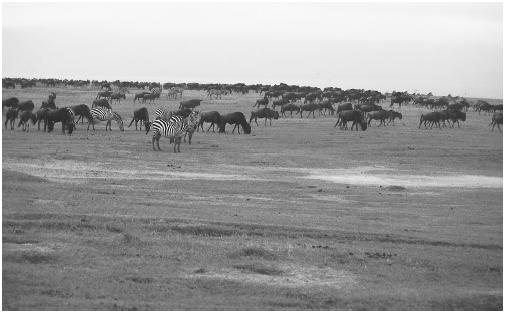
 Zebras and wildebeasts at Ngorongoro Crater, Serengeti National Park, Tanzania. (Photograph by Carolina Biological Supplies. Phototake. Reproduced by permission.)
The following sections of this BookRags Literature Study Guide is offprint from Gale's For Students Series: Presenting Analysis, Context, and Criticism on Commonly Studied Works: Introduction, Author Biography, Plot Summary, Characters, Themes, Style, Historical Context, Critical Overview, Criticism and Critical Essays, Media Adaptations, Topics for Further Study, Compare & Contrast, What Do I Read Next?, For Further Study, and Sources.
(c)1998-2002; (c)2002 by Gale. Gale is an imprint of The Gale Group, Inc., a division of Thomson Learning, Inc. Gale and Design and Thomson Learning are trademarks used herein under license.
The following sections, if they exist, are offprint from Beacham's Encyclopedia of Popular Fiction: "Social Concerns", "Thematic Overview", "Techniques", "Literary Precedents", "Key Questions", "Related Titles", "Adaptations", "Related Web Sites". (c)1994-2005, by Walton Beacham.
The following sections, if they exist, are offprint from Beacham's Guide to Literature for Young Adults: "About the Author", "Overview", "Setting", "Literary Qualities", "Social Sensitivity", "Topics for Discussion", "Ideas for Reports and Papers". (c)1994-2005, by Walton Beacham.
All other sections in this Literature Study Guide are owned and copyrighted by BookRags, Inc.
Zero discharge is the goal of eliminating discharges of pollutants by industry, government, and other agencies to air, water, and land with a view to protect both public health and the integrity of the environment. Such a goal is difficult to achieve except where there are point sources of pollution, and even then the cost of removing the last few percent of a given pollutant may be prohibitive. However, the goal is attainable in many specific cases (e.g., the electroplating industry), and is particularly urgent in the case of extremely toxic pollutants such as plutonium and dioxins. In other cases, it may be desirable as a goal even though it is not likely to be completely attained.
Zebras and wildebeasts at Ngorongoro Crater, Serengeti National Park, Tanzania. (Photograph by Carolina Biological Supplies. Phototake. Reproduced by permission.)
Zero discharge was actually proposed in the early 1970s by the United States Senate as an attainable goal for the Federal Water Pollution Control Acts Amendments of 1972. However, industry, the White House, and other branches of government lobbied intensely against it, and the proposal did not survive the legislative process.
Air Quality Criteria; Pollution Control; Water Quality Standards