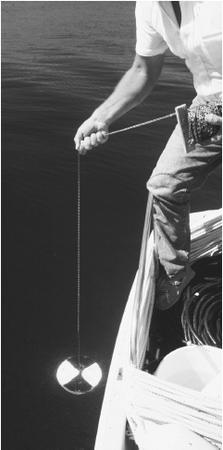
 Testing water clarity with a secchi disk. (Photograph by W.A. Banaszewski. Visuals Unlimited. Reproduced by permission.)
The following sections of this BookRags Literature Study Guide is offprint from Gale's For Students Series: Presenting Analysis, Context, and Criticism on Commonly Studied Works: Introduction, Author Biography, Plot Summary, Characters, Themes, Style, Historical Context, Critical Overview, Criticism and Critical Essays, Media Adaptations, Topics for Further Study, Compare & Contrast, What Do I Read Next?, For Further Study, and Sources.
(c)1998-2002; (c)2002 by Gale. Gale is an imprint of The Gale Group, Inc., a division of Thomson Learning, Inc. Gale and Design and Thomson Learning are trademarks used herein under license.
The following sections, if they exist, are offprint from Beacham's Encyclopedia of Popular Fiction: "Social Concerns", "Thematic Overview", "Techniques", "Literary Precedents", "Key Questions", "Related Titles", "Adaptations", "Related Web Sites". (c)1994-2005, by Walton Beacham.
The following sections, if they exist, are offprint from Beacham's Guide to Literature for Young Adults: "About the Author", "Overview", "Setting", "Literary Qualities", "Social Sensitivity", "Topics for Discussion", "Ideas for Reports and Papers". (c)1994-2005, by Walton Beacham.
All other sections in this Literature Study Guide are owned and copyrighted by BookRags, Inc.
A simple instrument used to measure the transparency of surface water bodies such as lakes and reservoirs. A Secchi disk is a metal, plastic, or wooden disk that is 8–12 in (20–30 cm) in diameter. It may be white or have alternating black and white quadrants. A long calibrated rope is attached to the center of the disk. Researchers use the disk by lowering it into the water, usually from the shaded side of a boat, and measuring the depth at which it just disappears from sight. The disk is then lowered a little more and then raised until it reappears. The average of the depths at which the disk disappears and then reappears is known as the Secchi depth. The amount of sediment, algae, and other solids in the water affects clarity and depth of light penetration and thus, Secchi depth. Scientists use this measure of transparency as a simple indication of water quality, often by comparing Secchi depth measurements over a period of time to track changes in the clarity of a particular water body.
Testing water clarity with a secchi disk. (Photograph by W.A. Banaszewski. Visuals Unlimited. Reproduced by permission.)