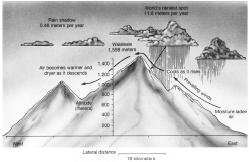
 A rain shadow in Hawaii on the eastern side of Mount Waialeale. (McGraw-Hill Inc. Reproduced by permission.)
The following sections of this BookRags Literature Study Guide is offprint from Gale's For Students Series: Presenting Analysis, Context, and Criticism on Commonly Studied Works: Introduction, Author Biography, Plot Summary, Characters, Themes, Style, Historical Context, Critical Overview, Criticism and Critical Essays, Media Adaptations, Topics for Further Study, Compare & Contrast, What Do I Read Next?, For Further Study, and Sources.
(c)1998-2002; (c)2002 by Gale. Gale is an imprint of The Gale Group, Inc., a division of Thomson Learning, Inc. Gale and Design and Thomson Learning are trademarks used herein under license.
The following sections, if they exist, are offprint from Beacham's Encyclopedia of Popular Fiction: "Social Concerns", "Thematic Overview", "Techniques", "Literary Precedents", "Key Questions", "Related Titles", "Adaptations", "Related Web Sites". (c)1994-2005, by Walton Beacham.
The following sections, if they exist, are offprint from Beacham's Guide to Literature for Young Adults: "About the Author", "Overview", "Setting", "Literary Qualities", "Social Sensitivity", "Topics for Discussion", "Ideas for Reports and Papers". (c)1994-2005, by Walton Beacham.
All other sections in this Literature Study Guide are owned and copyrighted by BookRags, Inc.
A rain shadow in Hawaii on the eastern side of Mount Waialeale. (McGraw-Hill Inc. Reproduced by permission.)
A region of relative dryness found on the downwind side of a mountain range or other upland area. As an air mass rises over the upwind side of a mountain range, pressure drops and temperature falls. This causes the relative humidity of the air mass to rise. Eventually the moisture in the air condenses and precipitation occurs. An air mass that is now cooler and drier passes over the top of the mountain range. As it descends on the downwind side of the range, it warms again and its relative humidity is further reduced. This reduction in relative humidity not only prevents further rainfall, but also causes the air mass to absorb moisture from other sources, drying the climate on the downwind side. The ultimate result is lush forest on the windward side of a mountain separated by the summit from an arid environment on the downwind side. Examples of rain shadows include the arid areas on the eastern sides of the mountain ranges of western North America, and the Atacama Desert in Chile on the downwind side of the Andes Mountains.