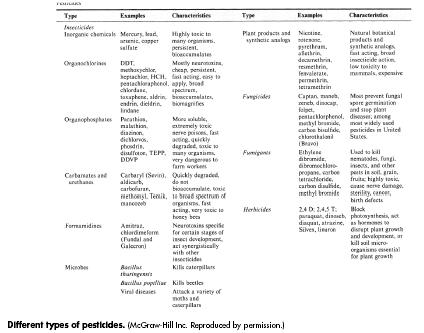
 Different types of pesticides. (McGraw-Hill Inc. Reproduced by permission.)
The following sections of this BookRags Literature Study Guide is offprint from Gale's For Students Series: Presenting Analysis, Context, and Criticism on Commonly Studied Works: Introduction, Author Biography, Plot Summary, Characters, Themes, Style, Historical Context, Critical Overview, Criticism and Critical Essays, Media Adaptations, Topics for Further Study, Compare & Contrast, What Do I Read Next?, For Further Study, and Sources.
(c)1998-2002; (c)2002 by Gale. Gale is an imprint of The Gale Group, Inc., a division of Thomson Learning, Inc. Gale and Design and Thomson Learning are trademarks used herein under license.
The following sections, if they exist, are offprint from Beacham's Encyclopedia of Popular Fiction: "Social Concerns", "Thematic Overview", "Techniques", "Literary Precedents", "Key Questions", "Related Titles", "Adaptations", "Related Web Sites". (c)1994-2005, by Walton Beacham.
The following sections, if they exist, are offprint from Beacham's Guide to Literature for Young Adults: "About the Author", "Overview", "Setting", "Literary Qualities", "Social Sensitivity", "Topics for Discussion", "Ideas for Reports and Papers". (c)1994-2005, by Walton Beacham.
All other sections in this Literature Study Guide are owned and copyrighted by BookRags, Inc.
The Pesticide Action Network is an international coalition of more than 300 nongovernmental organizations (NGOs) that works to stop both pesticide misuse and the proliferation of pesticide use worldwide. The Pesticide Action Network North America Regional Center (PANNA) is the North American member.
The Pesticide Action Network serves as a clearing-house to disseminate information to pesticide action groups and individuals in this country and abroad. It promotes research on and implementation of alternatives to pesticide use in agriculture, such as integrated pest management programs. With a library of 6,000 books, reports, articles, slides, and other materials, it sponsors a pesticide issues referral and information service.
Formerly called the Pesticide Education Action Project, which was founded in 1982, PANNA conducts the Dirty Dozen Campaign to "replace the most notorious pesticides with sustainable, ecologically sound alternatives." Various materials published by PANNA include brochures, pamphlets and books on United States pesticide problems and on global pesticide use. It publishes a quarterly newsletter, Global Pesticide Campaigner, and a bimonthly publication, PANNA Outlook.
The organization also publishes a number of books dealing with pesticides and pest control including Problem Pesticides, Pesticide Problems: A Citizen's Action Guide to the UN Food and Agriculture Organization's (FAO) International Code of Conduct on the Distribution and Use of Pesticides; FAO Code: Missing Ingredients; and Breaking the Pesticide Habit: Alternatives to 12 Hazardous Pesticides. While PANNA is not a membership organization for individuals outside of the member NGOs, it does offer subscriptions to its quarterly newsletter.
Different types of pesticides. (McGraw-Hill Inc. Reproduced by permission.)
Pesticide Action Network North America, 49 Powell St., Suite 500, San Francisco , CA USA 94102 (415) 981-1771 , Fax: (415) 981-1991 , Email: panna@panna.org,