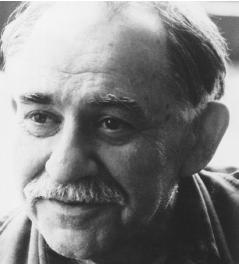
 Murray Bookchin. (Photograph by Debbie Bookchin. Reproduced by permission.)
The following sections of this BookRags Literature Study Guide is offprint from Gale's For Students Series: Presenting Analysis, Context, and Criticism on Commonly Studied Works: Introduction, Author Biography, Plot Summary, Characters, Themes, Style, Historical Context, Critical Overview, Criticism and Critical Essays, Media Adaptations, Topics for Further Study, Compare & Contrast, What Do I Read Next?, For Further Study, and Sources.
(c)1998-2002; (c)2002 by Gale. Gale is an imprint of The Gale Group, Inc., a division of Thomson Learning, Inc. Gale and Design and Thomson Learning are trademarks used herein under license.
The following sections, if they exist, are offprint from Beacham's Encyclopedia of Popular Fiction: "Social Concerns", "Thematic Overview", "Techniques", "Literary Precedents", "Key Questions", "Related Titles", "Adaptations", "Related Web Sites". (c)1994-2005, by Walton Beacham.
The following sections, if they exist, are offprint from Beacham's Guide to Literature for Young Adults: "About the Author", "Overview", "Setting", "Literary Qualities", "Social Sensitivity", "Topics for Discussion", "Ideas for Reports and Papers". (c)1994-2005, by Walton Beacham.
All other sections in this Literature Study Guide are owned and copyrighted by BookRags, Inc.
Born in New York in 1921, Bookchin is a writer, social critic, and founder of "social ecology." He has had a long and abiding interest in the environment, and as early as the 1950s he was concerned with the effects of human actions on the environment. In 1951 he published an article entitled
"The Problem of Chemicals," which exposed the detrimental effects of chemicals on nature and on human health. This work predates Rachel Carson's famous Silent Spring by over 10 years.
Murray Bookchin. (Photograph by Debbie Bookchin. Reproduced by permission.)
In developing his theory of social ecology, Bookchin makes the basic point that "you can't have sound ecological practices in nature without having sound social practices in society. Harmony in society means harmony with nature." Bookchin describes himself as an anarchist, contending that "there is a natural relationship between natural ecology and anarchy."
Bookchin has long been a critic of modern cities: his widely read and frequently quoted Crisis in Our Cities (1965) examines urban life, questioning "the lack of standards in judging the modern metropolis and the society that fosters its growth." His The Rise of Urbanization and the Decline of Citizenship (1987) continues the critique by advancing green ideas as a new municipal agenda for the 1990s and the next century. Though he is often mentioned as one of its founding thinkers, Bookchin is an ardent critic of deep ecology. He states: "Bluntly speaking, deep ecology, despite all its social rhetoric, has no real sense that our ecological problems have their roots in society and in social problems." Bookchin instead reaffirms a social ecology that is, first of all "social," incorporating people into the calculus needed to solve environmental problems, "avowedly rational," "revolutionary, not merely 'radical,'" and "radically" green.
Bookchin, Murray. Toward an Ecological Society. Montreal: Black Rose Books, 1980.
——. The Ecology of Freedom: The Emergence and Dissolution of Hierarchy. Palo Alto, CA: Cheshire Books, 1982.
——. Remaking Society: Pathways to a Green Future. Boston: South End Press, 1990.
Clark, J. "The Social Ecology of Murray Bookchin." In The Anarchist Moment. Montreal: Black Rose Books, 1984.
Bookchin, Murray. "Social Ecology Versus Deep Ecology." Socialist Review 18 (1988): 9–29.