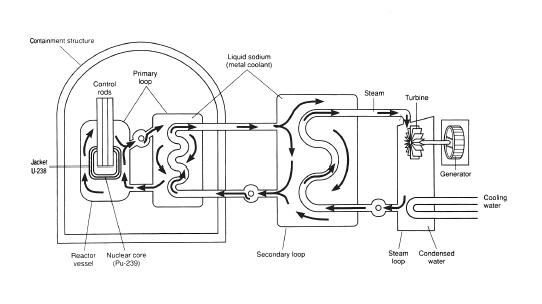
 Liquid metal fast breeder reactor. (McGraw-Hill Inc. Reproduced by permission.)
The following sections of this BookRags Literature Study Guide is offprint from Gale's For Students Series: Presenting Analysis, Context, and Criticism on Commonly Studied Works: Introduction, Author Biography, Plot Summary, Characters, Themes, Style, Historical Context, Critical Overview, Criticism and Critical Essays, Media Adaptations, Topics for Further Study, Compare & Contrast, What Do I Read Next?, For Further Study, and Sources.
(c)1998-2002; (c)2002 by Gale. Gale is an imprint of The Gale Group, Inc., a division of Thomson Learning, Inc. Gale and Design and Thomson Learning are trademarks used herein under license.
The following sections, if they exist, are offprint from Beacham's Encyclopedia of Popular Fiction: "Social Concerns", "Thematic Overview", "Techniques", "Literary Precedents", "Key Questions", "Related Titles", "Adaptations", "Related Web Sites". (c)1994-2005, by Walton Beacham.
The following sections, if they exist, are offprint from Beacham's Guide to Literature for Young Adults: "About the Author", "Overview", "Setting", "Literary Qualities", "Social Sensitivity", "Topics for Discussion", "Ideas for Reports and Papers". (c)1994-2005, by Walton Beacham.
All other sections in this Literature Study Guide are owned and copyrighted by BookRags, Inc.
The liquid metal fast breeder reactor (LMFBR) is a nuclear reactor that has been modified to increase the efficiency at which non-fissionable uranium-238 is converted to fissionable plutonium-239, which can be used as fuel in the production of nuclear power. The reactor uses "fast" rather than "slow" neutrons to strike a uranium-238 nucleus, resulting in the formation of plutonium-239. In a second modification, it uses a liquid metal, usually sodium, rather than neutron-absorbing water as a more efficient coolant. Since the reactor produces new fuel as it operates, it is called a breeder reactor.
The main appeal of breeder reactors is that they provide an alternative way of obtaining fissionable materials. The supply of natural uranium in the earth's crust is fairly large, but it will not last forever. Plutonium-239 from breeder reactors might become the major fuel used in reactors built a few hundred or thousand years from now.
However, the potential of LMFBRs has not as yet been realized. One serious problem involves the use of liquid sodium as coolant. Sodium is a highly corrosive metal and in an LMFBR it is converted into a radioactive form, sodium-24. Accidental release of the coolant from such a plant could, therefore, constitute a serious environmental hazard.
Liquid metal fast breeder reactor. (McGraw-Hill Inc. Reproduced by permission.)
Small-scale pilot LMFBR reactors have been tested in the United States, Saudi Arabia, Great Britain, and Germany since 1966, and all have turned out to be far more expensive than had been anticipated. The major United States research program based at Clinch, Tennessee, began in 1970. By 1983, the U. S. Congress refused to continue funding the project due to its slow and unsatisfactory progress.
Nuclear Fission; Nuclear Regulatory Commission; Radioactivity; Radioactive Waste Management
Cochran, Thomas B. The Liquid Metal Fast Breeder Reactor: An Environmental and Economic Critique. Baltimore: Johns Hopkins University Press, 1974.
Mitchell III, W., and S. E. Turner. Breeder Reactors. Washington, DC: U.S. Atomic Energy Commission, 1971.
International Nuclear Information System. Links to Fast Reactor Related Sites. June 7, 2002 [June 21, 2002].