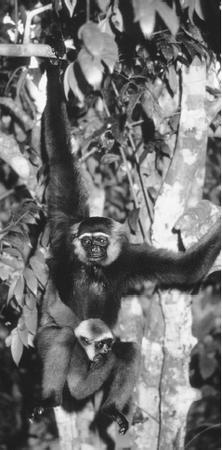
 A gibbon. (©Breck P. Kent/JLM Visuals. Reproduced by permission.)
The following sections of this BookRags Literature Study Guide is offprint from Gale's For Students Series: Presenting Analysis, Context, and Criticism on Commonly Studied Works: Introduction, Author Biography, Plot Summary, Characters, Themes, Style, Historical Context, Critical Overview, Criticism and Critical Essays, Media Adaptations, Topics for Further Study, Compare & Contrast, What Do I Read Next?, For Further Study, and Sources.
(c)1998-2002; (c)2002 by Gale. Gale is an imprint of The Gale Group, Inc., a division of Thomson Learning, Inc. Gale and Design and Thomson Learning are trademarks used herein under license.
The following sections, if they exist, are offprint from Beacham's Encyclopedia of Popular Fiction: "Social Concerns", "Thematic Overview", "Techniques", "Literary Precedents", "Key Questions", "Related Titles", "Adaptations", "Related Web Sites". (c)1994-2005, by Walton Beacham.
The following sections, if they exist, are offprint from Beacham's Guide to Literature for Young Adults: "About the Author", "Overview", "Setting", "Literary Qualities", "Social Sensitivity", "Topics for Discussion", "Ideas for Reports and Papers". (c)1994-2005, by Walton Beacham.
All other sections in this Literature Study Guide are owned and copyrighted by BookRags, Inc.
Gibbons (genus Hylobates, meaning "dweller in the trees") are the smallest members of the ape family which also includes gorillas, chimpanzees, and orangutans. They spend most of their lives at the tops of trees in the jungle, eating leaves and fruit. They are extremely agile, swinging at speeds of 35 mph (56 km/h) with their long arms on branches to move from tree to tree. The trees can even be 50 ft (15 m) apart. They have no tails and are often seen walking upright on tree branches. Gibbons are known for their loud calls and songs, which they use to announce their territory and warn away others. They are devoted parents, raising usually one or two offspring at a time and showing extraordinary affection in caring for them. Conservationists and animal protectionists who have worked with gibbons describe them as extremely intelligent, sensitive, and affectionate.
Gibbons have long been hunted for food, for medical research, and for sale as pets and zoo specimens. A common method of collecting them is to shoot the mother and capture the nursing or clinging infant, if it is still alive. The mortality rate in collecting and transporting gibbons to areas where they can be sold is extremely high. This, coupled with the fact that their jungle habitat is being destroyed at a rate of 32 acres (13 ha) per minute, has resulted in severe depletion of their numbers.
A gibbon. (©Breck P. Kent/JLM Visuals. Reproduced by permission.)
Gibbons are found in southeast Asia, China, and India, and nine species are recognized. All nine species are considered endangered by the U.S. Department of the Interior and are listed in the most endangered category of the Convention on International Trade in Endangered Species of Wild Fauna and Flora (CITES). IUCN—The World Conservation Union considers three species of gibbon to be endangered and two species to be vulnerable. Despite the ban on international trade in gibbons conferred by listing in Appendix I of CITES, illegal trade in gibbons, particularly babies, continues on a wide scale in markets throughout Asia.
Benirschke, K. Primates: The Road to Self-sustaining Populations. New York: Springer-Verlag, 1986.
Preuschoft, H., et al. The Lesser Apes: Evolutionary and Behavioral Biology. Edinburgh: Edinburgh University Press, 1984.
International Center for Gibbon Studies. [cited May 2002].