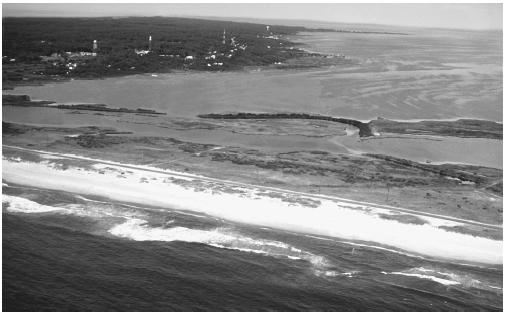
 Located parallel to coastlines, Barrier islands attract visitors that now pose a significant threat to the birds and other coastal species living there. (JLM Visuals. Reproduced by permission.)
The following sections of this BookRags Literature Study Guide is offprint from Gale's For Students Series: Presenting Analysis, Context, and Criticism on Commonly Studied Works: Introduction, Author Biography, Plot Summary, Characters, Themes, Style, Historical Context, Critical Overview, Criticism and Critical Essays, Media Adaptations, Topics for Further Study, Compare & Contrast, What Do I Read Next?, For Further Study, and Sources.
(c)1998-2002; (c)2002 by Gale. Gale is an imprint of The Gale Group, Inc., a division of Thomson Learning, Inc. Gale and Design and Thomson Learning are trademarks used herein under license.
The following sections, if they exist, are offprint from Beacham's Encyclopedia of Popular Fiction: "Social Concerns", "Thematic Overview", "Techniques", "Literary Precedents", "Key Questions", "Related Titles", "Adaptations", "Related Web Sites". (c)1994-2005, by Walton Beacham.
The following sections, if they exist, are offprint from Beacham's Guide to Literature for Young Adults: "About the Author", "Overview", "Setting", "Literary Qualities", "Social Sensitivity", "Topics for Discussion", "Ideas for Reports and Papers". (c)1994-2005, by Walton Beacham.
All other sections in this Literature Study Guide are owned and copyrighted by BookRags, Inc.
An elongated island that lies parallel to, but mostly separate from, a coastline. Barrier islands are composed of sediments, mainly sand, deposited by longshore currents, wind, and wave action. Both marine and terrestrial plants and animals find habitat on barrier islands or along their sandy beach shorelines. These islands also protect coastal lagoons from ocean currents and waves, providing a warm, quiet environment for species that cannot tolerate more violent wind and wave conditions. In recent decades these linear, sandy islands, with easy access from the mainland, have proven a popular playground for vacationers. These visitors now pose a significant threat to breeding birds and other coastal species. Building houses, roads, and other disruptive human activities can destabilize dunes and expose barrier islands to disastrous storm damage. In some cases, whole islands are swept away, exposing protected lagoons and delicate wetlands to further damage. Major barrier island formations in North America include those along the eastern coasts of the mid-Atlantic states, Florida, and the Gulf of Mexico.
Located parallel to coastlines, Barrier islands attract visitors that now pose a significant threat to the birds and other coastal species living there. (JLM Visuals. Reproduced by permission.)