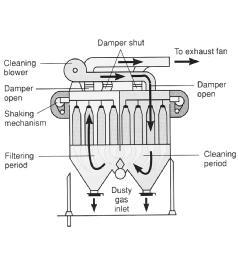
 Baghouse. (McGraw-Hill Inc. Reproduced by permission.)
The following sections of this BookRags Literature Study Guide is offprint from Gale's For Students Series: Presenting Analysis, Context, and Criticism on Commonly Studied Works: Introduction, Author Biography, Plot Summary, Characters, Themes, Style, Historical Context, Critical Overview, Criticism and Critical Essays, Media Adaptations, Topics for Further Study, Compare & Contrast, What Do I Read Next?, For Further Study, and Sources.
(c)1998-2002; (c)2002 by Gale. Gale is an imprint of The Gale Group, Inc., a division of Thomson Learning, Inc. Gale and Design and Thomson Learning are trademarks used herein under license.
The following sections, if they exist, are offprint from Beacham's Encyclopedia of Popular Fiction: "Social Concerns", "Thematic Overview", "Techniques", "Literary Precedents", "Key Questions", "Related Titles", "Adaptations", "Related Web Sites". (c)1994-2005, by Walton Beacham.
The following sections, if they exist, are offprint from Beacham's Guide to Literature for Young Adults: "About the Author", "Overview", "Setting", "Literary Qualities", "Social Sensitivity", "Topics for Discussion", "Ideas for Reports and Papers". (c)1994-2005, by Walton Beacham.
All other sections in this Literature Study Guide are owned and copyrighted by BookRags, Inc.
An air pollution control device normally using a collection of long, cylindrical, fabric filters to remove particulate matter from an exhaust air stream. The filter arrangement is normally designed to overcome problems of cleaning and handling large exhaust volumes. In most cases, exhaust gas enters long (usually 33–50 ft [10–15 m]), vertical, cylindrical filters on the inside from the bottom. The bags are sealed at the top. As the exhaust air passes through the fabric filter, particles are separated from the air stream by sticking either to the filter fabric or to the cake of particles previously collected on the inside of the filter. The exhaust then passes to the atmosphere free of most of its original particulate-matter loading; collection efficiency usually increases with particle size.
Baghouse. (McGraw-Hill Inc. Reproduced by permission.)
The buildup of particles on the inside of the bags is removed periodically by various methods, such as rapping the bags, pulsing the air flow through the bags, or shaking. The particles fall down the long cylindrical bags and are normally caught in a collection bin, which is unloaded periodically. A baghouse system is usually much cheaper to install and operate than a system using electrostatic precipitation to remove particulates.